
Three articles – available here, here and here – submitted for publication in “The Astrophysical Journal” report various aspects of a study of the TOI 700 system and the discovery of three exoplanets thanks to the observations made by NASA’s TESS space telescope. Several researchers collaborated to confirm the existence of the three exoplanets and to study their characteristics, in particular TOI 700 d, the outermost and the only one of the three to orbit in the habitable zone of its system. Its existence was also confirmed using the Spitizer space telescope making it the first rocky exoplanet discovered by TESS in the habitable zone.
Just over 100 light years from Earth, the star TOI 700, also known by other designations according to the catalog but indicated in this research with the one derived from the acronym meaning “TESS Object of Interest”, has a mass and diameter a little higher than 40% of the Sun’s. Its surface temperature is approximately half the Sun’s, therefore its system’s habitable zone is much closer to it than Earth is from the Sun.
The TESS (Transiting Exoplanet Survey Satellite) space telescope was launched on April 18, 2018, taking the planet hunter legacy from the Kepler space telescope. The star TOI 100 appears in 11 of the 13 sectors observed by TESS during the first year of its mission and this allowed to observe multiple transits of its three exoplanets in front of it, obtaining a lot of data that allowed to estimate their characteristics. However, TOI 100 was originally classified as a Sun-like star and this initially led to consider the discovery of three exoplanets less interesting because a star considered larger meant that its planets were also considered larger and hotter. Some citizen scientists discovered the error allowing to correct it and to understand that the outermost exoplanet is in its system’s habitable zone.
The innermost planet, TOI 700 b, has an estimated mass and size very similar to the Earth’s and is most likely rocky. Its year lasts almost exactly 10 Earth days so it’s too close to its star to host life forms similar to the Earth’s but if it has an atmosphere it could be a Venus twin. The second planet, TOI 700 c, is probably a gaseous sub-Neptune with an estimated mass at a peak of probability at about 7.5 times the Earth’s for a radius that is about 2.63 times the Earth’s and a year that lasts almost exactly 16 Earth days.
The outermost and the most interesting planet, TOI 700 d, is probably a super-Earth with an estimated mass at a peak of probability at about 1.72 times the Earth’s for a radius that is about 1.2 times the Earth’s. These are characteristics that make it potentially habitable because its year slightly longer than 37 Earth days puts it close to the inner limit of its system’s habitable zone.
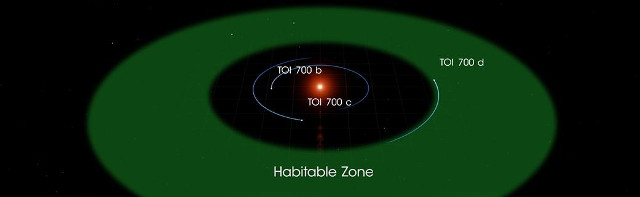
The top image (NASA’s Goddard Space Flight Center) shows a scheme of the TOI 700 system with the orbits of its planets. The bottom image (NASA’s Goddard Space Flight Center) shows an artist’s concept of the exoplanet TOI 700 d.
A serious problem concerning the potential habitability of exoplanets that orbit red dwarfs is that they’re small but can have very violent flares, which consequently can affect their exoplanets with significant amounts of high-energy particles. TOI 100 looks like a fairly quiet star, a positive element in assessing its planets’ characteristics.
Actually, for the moment there’s not much information useful to estimate the probability that the exoplanet TOI 700 d is potentially habitable. The spectral data of the emissions from the planet are limited and this could make it very difficult to verify the presence of an atmosphere even with new instruments such as the James Webb space telescope.
The TOI 700 system will certainly be subject to further studies, also because it hosts a gas planet between two rocky planets. So far, only neighboring rocky planets and neighboring gas planets were found in multiple planetary systems. This exception represents a mystery that adds interest to this system.

