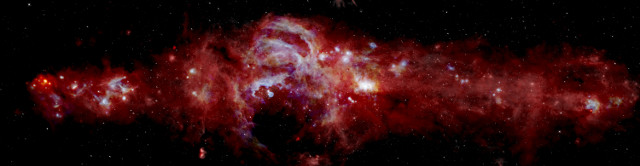
An article submitted for publication in “The Astrophysical Journal” reports the initial results of an investigation about the center of the Milky Way conducted using the SOFIA flying telescope to capture infrared details never seen before and therefore useful for mapping an area 600 light years across. A team of researchers integrated those observations with data previously collected using NASA’s Spitzer space telescope and ESA’s Herschel space observatory obtaining a map of the center of the galaxy useful for example to understand where gas is concentrated which can lead to the new stars’ formation, how some of the most massive stars in the Milky Way formed in a relatively small region or where materials are likely to be devoured by the supermassive black hole at the center of the galaxy.
The flying SOFIA (Stratospheric Observatory for Infrared Astronomy) observatory is a project of NASA and DLR, the German space agency, which uses a modified Boeing 747SP to allow the use of a telescope of 2.5 meters in diameter.
The center of the Milky Way is a place full of stars and gas that orbit around Sagittarius A*, the supermassive black hole with an estimated mass of around 4 million times the Sun’s. The presence of gas is not so high as to absorb the electromagnetic emissions but there are certain bands in which that area is much brighter. For example, in November 2019 three articles published in the journal “Publications of the Astronomical Society of Australia (PASA)” reported some results of the GaLactic and Extragalactic All-sky MWA (GLEAM) survey, based on detections of low frequency radio emissions. Infrared can be detected in abundance as well so the SOFIA flying telescope is excellent for this type of research.
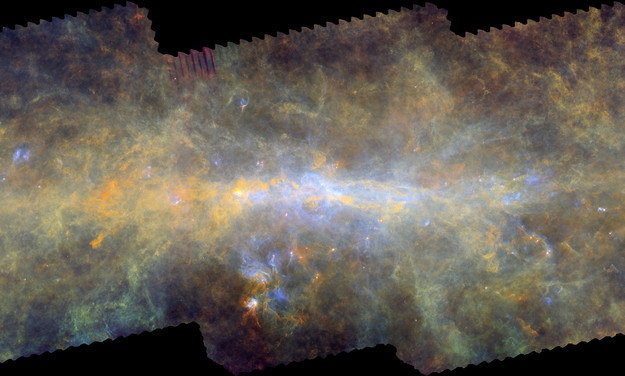
In particular, it was the SOFIA flying telescope’s FORCAST (Faint Object Infrared Camera for the SOFIA Telescope) infrared camera that captured images of warm regions of the center of the Milky Way, precisely the ones that offer intense infrared emissions than other instruments, especially ground-based, are unable to detect. Those images were combined with those of extremely hot and cold materials captured at various infrared frequencies by the Spitzer space telescope and the Herschel space observatory. The top image (NASA/SOFIA/JPL-Caltech/ESA/Herschel) is a final composition of an area 600 light years across with the data detected by SOFIA in blue and green (at wavelengths of 25 and 37 microns), those detected by Herschel in red (at 70 microns) and those detected by Spitzer in white (at 8 microns).
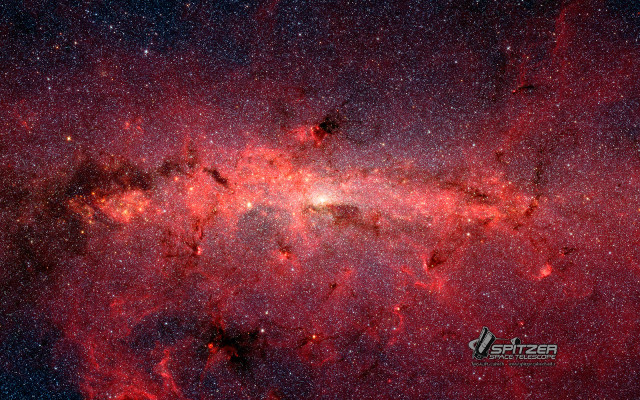
The observations made with the SOFIA flying telescope allowed to capture a lot of new details of the center of the Milky Way. James Radomski, a scientist at SOFIA Science Center at NASA’s Ames Research Center, stated that studying that area is like trying to assemble a puzzle with missing pieces and that the data collected by SOFIA fill some of the holes, bringing us significantly closer to a full image.
At the center of the Milky Way there’s a concentration of gas higher than the rest of the galaxy, yet the amount of massive stars is ten times lower than expected. Infrared observations, including the new ones from SOFIA, will help to understand its causes.
The new observations show details of the birth of stars near the Quintuplet cluster and hot materials near the Arches cluster which could lead there too to the birth of new stars. The new observations could help understand how some of the most massive stars in the Milky Way formed so close to each other while in the surrounding area there’s a poor star formation.
Around Sagittarius A* there’s a ring of materials with a diameter of about 10 light years. Those materials are slowly devoured by the supermassive black hole. SOFIA’s observations allow to see it more clearly. The evolution of that ring isn’t clear so it’s useful to have details about materials that seem to be incorporated into it.
These are some of the main targets for further follow-up research that will be able to take advantage of these new observations made with the SOFIA flying telescope. Other regions of which new details were captured may be the focus of new studies, also after the activation of new instruments capable of observing those areas of the Milky Way in depth.