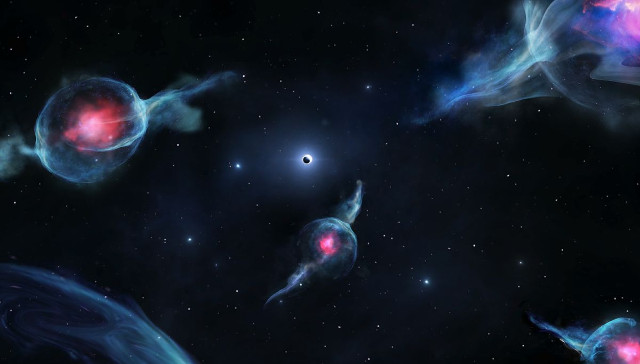
An article published in the journal “Nature” reports the identification of what were called G-objects that orbit the supermassive black hole at the center of the Milky Way, Sagittarius A* or simply Sgr A*. A team of researchers led by Anna Ciurlo of UCLA already announced the discovery of three new G-objects, now they confirm their existence and announce the identification of a fourth one. They add to the two G-objects already confirmed a few years ago. New indications could confirm the hypothesis that they’re the result of mergers of binary systems’ stars.
The object cataloged as G1 was discovered in 2004, G2 was discovered in 2012. They raised interest because they orbit Sagittarius A* and for their strange characteristics, partly like dust clouds and partly like stars, raised puzzlement among astronomers. During the 232nd meeting of the American Astronomical Society held in June 2018, a team of researchers led by Anna Ciurlo of UCLA presented the results of a research that led to the discovery of three more objects with the same characteristics, G3, G4 and G5. The researchers concluded that these are bloated stars that have become so large that the tidal forces exerted by Sagittarius A* can tear materials from their atmosphere when they approach the black hole.
The search didn’t stop there and the examination of more data collected at the Keck Observatory in Hawaii led to the discovery of a new object with the same characteristics, which was cataloged as G6. The orbits of these objects are very different around Sagittarius A* and this confirms that they’re not gas clouds, which under the conditions existing in the area around the supermassive black hole would be transient phenomena. The new observations seem to confirm the theory that these are bloated stars that are very large because they’re the result of star mergers. That theory was first proposed in an article published in November 2014 in “The Astrophysical Journal Letters” by a team led by Dr Gunther Witzel of UCLA. Some members of that team later joined the team led by Anna Ciurlo.
UCLA’s astrophysicist Andrea Ghez, part of the teams that conducted the various studies on G-objects, stated that stellar mergers could occur more often than we thought and that black holes could induce those mergers. She also pointed out that many known stars that we don’t understand could be the final product of mergers in a stable phase.
The very powerful gravity of Sagittarius A* could have induced various mergers that generated the G-objects through oscillations of eccentricity due to what’s called the Kozai-Lidov mechanism. The merger would cause the stars’ outer layers to swell, generating a cloud of dust and gas that hides their central mass for a long time.
The top image (Courtesy Anna Ciurlo, Tuan Do/UCLA Galactic Center Group. All rights reserved) shows the orbits of the various G-objects at the center of the galaxy with the supermassive black hole indicated by the white cross. The bottom image (Courtesy Jack Ciurlo. All rights reserved) shows an artist’s representation of the G-objects with the reddish centers and the supermassive black hole represented by a black sphere inside a white ring.
The researchers identified more candidates that could be other objects similar to the six G-objects and the analysis of the collected data continues. The central area of the galaxy is very dense and Sagittarius A* has a remarkable influence. Understanding what happens at the center of the Milky Way will help understand the evolution of the entire galaxy and allow to improve other galaxies’ evolution models.