
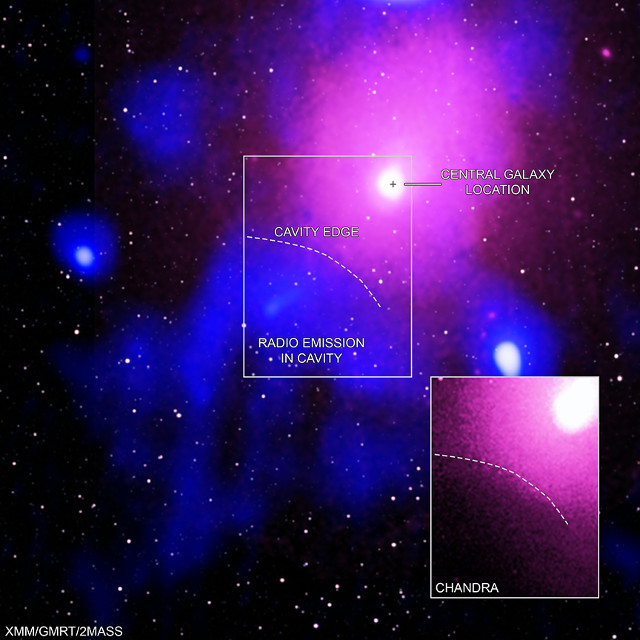
An article published in “The Astrophysical Journal” reports the observation of what was called the largest explosion discovered in the universe after the Big Bang and caused by the supermassive black hole in the galaxy at the center of the Ophiuchus supercluster. A team of astronomers led by Simona Giacintucci of the Naval Research Laboratory combined X-ray observations with ESA’s XMM-Newton and NASA’s Chandra space telescopes with those at radio frequencies conducted with Murchison Widefield Array (MWA) and Giant Metrewave Radio Telescope (GMRT) radio telescopes to map the cavity generated by that cataclysmic event, about 15 times the Milky Way’s size.
At a distance between 370 and 390 million light years from Earth, the Ophiuchus supercluster is a colossal cosmic structure made up of thousands of galaxies that can be divided into less colossal clusters that are still joined together by mutual gravitational attraction. At the center of that supercluster there’s a massive galaxy that hosts the supermassive black hole which, according to the Simona Giacintucci team, is at the origin of an event that defining an outburst is an understatement since it ejected significant jets of materials at relativistic speeds. The energy released was estimated at about five times that of the event that held the record, another outburst generated by a supermassive black hole observed in 2003 in the galaxy cluster MS0735.6+7421.
A team led by Norbert Werner found the first clues of the cataclysmic event in the Ophiuchus supercluster, reporting them in an article published in August 2016 in the journal “Monthly Notices of the Royal Astronomical Society”. They ended up attributing those clues to processes linked to a galaxy merger, discarding the hypothesis of an outburst of energy coming from the supermassive black hole because the energy needed to generate a cavity of the observed size seemed really too colossal even for the activity of what’s called the active galaxy nucleus. Now, however, the new observations put together by Simona Giacintucci’s team indicate that it was precisely that type of activity that dug a cavity the size of 15 galaxies as large as the Milky Way in the Ophiuchus supercluster’s gas.
In this new research, the old X-ray observations conducted with the Chandra X-ray Observatory were combined with those of the XMM-Newton space telescope, which confirmed the presence of the cavity’s curved edge. Other data were collected from observations at radio frequencies conducted with the Murchison Widefield Array (MWA) radio telescope in Australia and from the archives of the Giant Metrewave Radio Telescope (GMRT) in India, which indicated that the curved edge surrounds a region where electrons accelerated at speeds close to that of light fill the cavity with significant radio emissions. All this is evidence of an outburst of unprecedented size.
The composite image (X-ray: Chandra: NASA/CXC/NRL/S. Giacintucci, et al., XMM: ESA/XMM; Radio: NCRA/TIFR/GMRT; Infrared: 2MASS/UMass/IPAC-Caltech/NASA/NSF) shows the region where the outburst was observed. In pink, the diffused hot gas revealed by XMM-Newton. In blue the radio data obtained from the GMRT radio telescope. In white, infrared data from the 2MASS survey. The inset at the bottom right shows a zoom based on the X-ray data obtained with Chandra (also represented in pink), while bright points scattered throughout the rest of the image reflect the distribution of stars and galaxies in the foreground.
The observed cavity was called a fossil because at the moment there’s no evidence from the Earth of an active galaxy nucleus in the galaxy at the center of the Ophiuchus supercluster. In essence, the cavity is what remains of the explosive activity generated hundreds of millions of years ago when a significant amount of materials got swallowed up by the supermassive black hole that fed that active galaxy nucleus and a part of them was ejected through two extremely powerful jets at its poles.
According to the researchers, this cavity could be an example of a new class of radio sources that can be discovered in surveys that are very sensitive to low frequencies. The detection of their X-ray counterpart is complex and this explains why it took years to find evidence of what happened in the Ophiuchus supercluster. Many quasars are known, powered by very active supermassive black holes, so it’s possible that follow-up studies with the right instruments might allow to find traces of other cosmic explosions at similar levels. Again, astronomers discovered activities that are extreme even by the standards of objects that are already extreme.
