
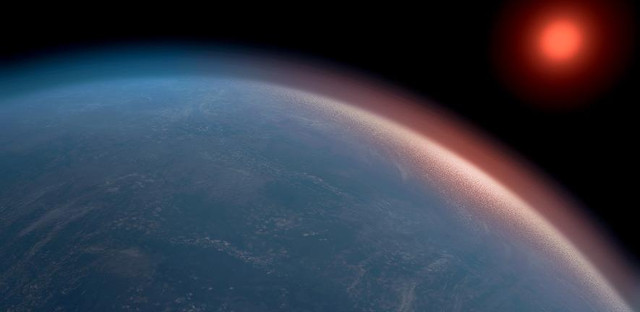
An article published in “The Astrophysical Journal Letters” reports a study on the potential habitability conditions of the exoplanet K2-18b. A team from the British University of Cambridge led by Nikku Madhusudhan conducted a series of simulations based on the possible values of mass, size, and atmosphere data value available on it to create various models compatible with the observations. According to the conclusions, under certain conditions there may be liquid water on its surface.
With an estimated radius between 2.24 and 2.6 times the Earth’s and an estimated mass around 8 times the Earth’s, the exoplanet K2-18b could be a super-Earth but the doubt remains that it could be a mini-Neptune. Its density is between the Earth’s and Neptune’s, complicating the analysis of information that still contains various approximations. An article published in September 2019 in the journal “Nature Astronomy” reported the detection of water vapor in the atmosphere of the exoplanet K2-18b offering some interesting information, and an article published in the journal “The Astrophysical Journal Letters” in December 2019 offered more on the same topic. However, it was still impossible to offer certain answers.
Precisely because of the uncertainties that still exist, the Cambridge team tried to create planetary models in which K2-18b goes from the rocky planet to the water world passing through the mini-Neptune possibility. If it were a rocky planet with a large iron core and very little water, the atmospheric pressure would have to be enormous, around a million Earth’s atmospheres, making the water solid. If it were a mini-Neptune, the atmospheric pressure would be around 700 Earth’s atmospheres, but the temperature would be around 1,200° Celsius. If it were an water world, the atmospheric pressure would be around 130 Earth’s atmospheres, and the temperature would be around 287° Celsius. In essence, these are cases in which K2-18b wouldn’t be habitable by life forms similar to Earth’s.
A model of K2-18b more compatible with Earth-like life forms includes a rocky core of less than 15% of the mass with a less massive atmosphere. The water could be liquid at about 30° with pressures between 1 and 10 Earth’s atmospheres. However, a lot depends on its atmosphere’s characteristics, and further observations will be needed to obtain accurate information. Confirmations of the presence of methane and ammonia arrived but it’s not possible to establish whether they were generated by biological or other processes.
The force of gravity on the exoplanet K2-18b is quite higher than the Earth’s, and the environmental conditions could be rather extreme by Earth standards but on Earth there are living creatures even in the abysses. In essence, the actual probabilities that K2-18b is habitable have yet to be ascertained but this study is interesting because it offers ideas for the search for life forms on exoplanets significantly more massive than Earth.
