
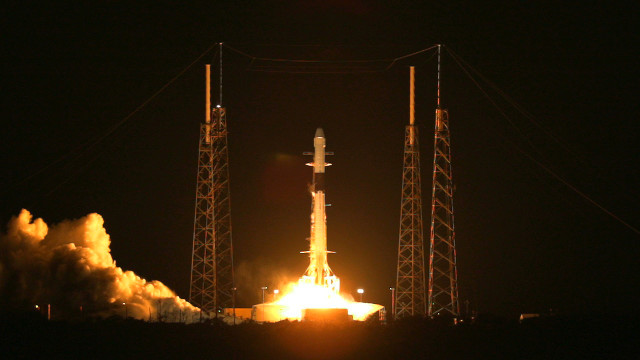
A few hours ago the SpaceX Dragon spacecraft blasted off atop a Falcon 9 rocket from Cape Canaveral in its CRS-20 (Cargo Resupply Service 20) mission, also referred to as SPX-20. After just over ten minutes it separated successfully from the rocket’s last stage and went en route. This is the 20th mission for the Dragon spacecraft to resupply the International Space Station with various cargoes and then return to Earth, again with various cargoes. It’s the last mission for this Dragon version, which will be replaced by Dragon 2 from the next mission.
The Dragon spacecraft’s cargo is a little almost 2,000 kg (almost 4,360 lbs) between the pressurized and the non pressurized section. There are about 273 kg (a little more than 600 lbs) of food and other supplies for the International Space Station crew but most of the cargo consists of instruments, hardware and various other materials needed to science experiments and research conducted aboard the Station.
ESA’s Bartolomeo platform, which will be connected to the Columbus module, is a new space laboratory that will provide new opportunities for scientific experiments outside the International Space Station. It was created also in anticipation of collaborations with commercial users, companies interested in research on various materials and technologies that can obtain advantages from tests conducted in microgravity conditions.
The Droplet Formation Studies in Microgravity (Droplet Formation Study) experiment will study the formation of droplets produced using Delta Faucet’s H2Okinetic shower technology. The aim is to optimize the use of water in an environment where it’s precious.
The Organ-Chips as a Platform for Studying Effects of Space on Human Enteric Physiology (Gut on Chip) experiment aims to study the effects of microgravity on human cells grown in an instrument called Organ-Chip.
Another biological experiment is Generation of Cardiomyocytes From Human Induced Pluripotent Stem Cell-derived Cardiac Progenitors Expanded in Microgravity (MVP Cell-03), which aims to grow human heart cells in microgravity.
In recent years various tests have been carried out on 3D printers built to work in microgravity and allow the crew to produce the tools they need on board the International Space Station. The Nonequilibrium Processing of Particle Suspensions with Thermal and Electrical Field Gradients (ACE-T-Ellipsoids) experiment is one of them.
Groups of mice are often sent to the International Space Station to conduct biological experiments. The Rodent Research-23 (RR-23) investigation is accompanied by the Rodent Research Habitats and Hardware, which includes the Mouse Habitat Unit-5 (MHU-5) provided by the Japanese space agency JAXA to examine the effects of different gravity levels on mice.
The Dragon spacecraft is the same that was already used in the CRS-10 mission, started on February 19, 2017, and CRS-16, started on December 5, 2018. By now even the use of a cargo ship for a third time is becoming normal, a sign that the reuse of the Dragon is more and more a routine.
The Falcon 9 rocket’s first stage landed at Cape Canaveral marking the 50th success in the controlled landing. Now the Dragon cargo spacecraft is en route to the International Space Station and everything proceeds normally. The arrival is scheduled for Monday: at about noon UTC, the Dragon is scheduled to be captured by the Station’s robotic arm.

Permalink