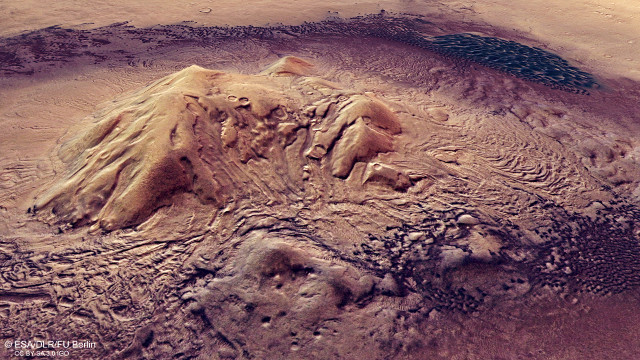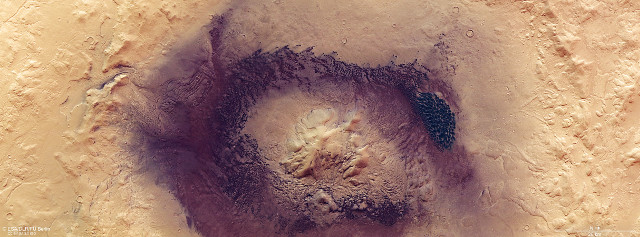
ESA has released new photos of Moreux Crater on the planet Mars taken by the Mars Express space probe’s High Resolution Stereo Camera (HRSC). It’s an impact crater, but shows characteristics that are out of normal, considered the result of erosion caused by glacial processes. Glaciations probably occurred in different periods since the geological traces present in the area suggest that they occurred even in the last millions of years. Another reason for interest in this crater is the presence of dunes inside it, which provide information on the winds blowing in the area.
The top image (ESA/DLR/FU Berlin, CC BY-SA 3.0 IGO) shows a view of Moreux Crater obtained from observations by the Mars Express space probe of October 39, 2019. The bottom image (ESA/DLR/FU Berlin, CC BY-SA 3.0 IGO) shows a perspective view of Moreux Crater obtained from those observations.
Moreux Crater is located in the area called Protonilus Mensae, part of a larger area called Terra Sabaea, in turn part of the Ismenius Lacus quadrangle. It has a diameter of about 135 kilometers, but its shape has been altered and today it’s oval, It has a depth that reaches about 3 kilometers, and at its center there’s a mountain that has a height of about 2 kilometers. The mountain is a typical formation of impact craters in which the materials got liquefied by the intense heat, got projected outwards, and part of them rebounded gathering at the center of the crater.
According to scientists, the dunes inside Moreux Crater and also those around it contain sandy materials rich in pyroxene and olivines. These are minerals that form mafic rocks, which means that they contain magnesium and iron. These are minerals that have a typical dark color and contribute to the variety of colors present in the area.
Martian winds are considered crucial in the formation of the dunes by sweeping basaltic volcanic sand and ash which accumulated mainly inside Moreux Crater. Single dunes and continuous dune fields were formed over time and it’s not only the grouping that is variable because in the dune field north of the central mountain, amounts of olivine were found that are far superior to the other dunes.
For scientists, the most interesting part of the Moreux crater are the traces left by past glaciations. The analysis of the shapes present on the ground such as valleys carved into the crater flanks offers some dating of the glacial processes that generated them. The result suggests a series of glaciations that occurred between a billion and 400,000 years ago.
The glacial processes occurred mainly when the rotation axis of Mars had a greater inclination and even the polar areas were more oriented towards the Sun. At latitudes like that of Moreux Crater, more ice and snow from the atmosphere deposited on the crater’s edges and on the plateaus, where it formed glaciers.
The traces of the many geological and atmospheric processes left on Moreux Crater help scientists to reconstruct its history. Often the interest is focused on the first part of Mars history, when the red planet was similar to Earth, but the relatively recent one, much later than the climate collapse, is useful as well, for example, to understand in which conditions glaciers can form.