
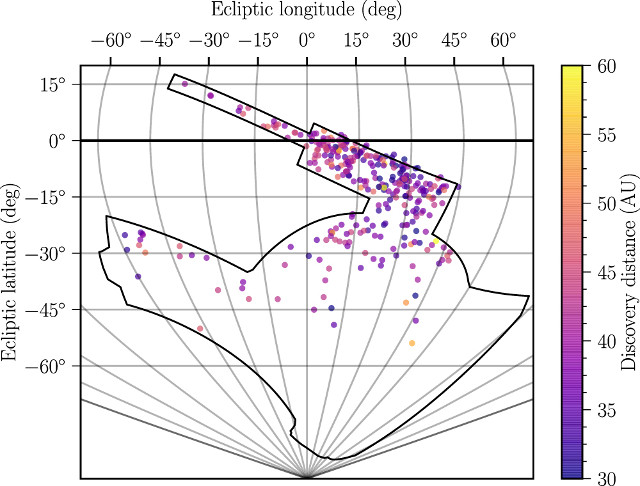
An article published in “The Astrophysical Journal” presents a catalog of 316 trans-neptunian objects detected by the Dark Energy Survey (DES) during the first four years of operations. A team led by Pedro Bernardinelli analyzed the data collected with a patient work to eliminate the fixed objects and then focused on the transient ones until they obtained the identification of 245 objects already known and 139 that were hitherto unknown. They’re at distances between 30 and more than 90 times the Earth’s from the Sun. Their detection will help to understand their origin and in general the Kuiper belt, where someone thinks that there may be another planet.
In early 2019, the announcement of the end of the six years of Dark Energy Survey (DES) arrived. It’s a global research aimed at mapping a portion of the sky at an unprecedented level of detail. The considerable effort made is only the first phase of the work, which was followed by the beginning of the analysis of the data collected to study the expansion of the universe and what’s called dark energy. It’s one of the major mysteries of today’s cosmology since dark energy was hypothesized to explain why the expansion of the universe is accelerating but absolutely nothing is known about it.
The images collected by the Dark Energy Camera will allow to obtain more precise measurements of the speed of the universe expansion and also a more precise map of dark matter, another mystery of current cosmology. In both dark energy and dark matter’s case, the results that will be obtained in the coming years from these studies will also allow testing alternative hypotheses.
A long, complex and above all detailed investigation such as DES can’t be of limited use to the cosmological studies for which it was carried out. In the images collected, about 7 billion objects have been identified among galaxies, stars and even smaller objects in the solar system. That means that by identifying the moving objects it’s possible to understand which of them are trans-neptunians, the ones within the solar system but beyond the orbit of the planet Neptune.
To obtain confirmation of the nature of the 400 candidates identified after the long elimination work, Pedro Bernardinelli’s team kept them under observation for 25 more nights. Fake signals were added to make sure that they couldn’t give wrong results. 245 traces identified match already known trans-neptunian objects, another confirmation that the job was done correctly. 139 objects were unknown and added to the list, which now includes around 3,000 objects.
The image (courtesy Pedro Bernardinelli. All rights reserved) shows the position of the detected objects. The color indicates the distance in astronomical units where one unit is the average distance of the Earth from the Sun. The two most distant objects are more than 90 astronomical units away.
Various astronomers are looking for another planet in the Kuiper belt. Knowing the position and orbits of other objects in that area of the solar system is also useful in this type of search. The hypothesis made so far are also based on the possible gravitational effects detected on some of these objects, but if there are other unknown objects the calculations of those effects could be wrong. Knowing those objects is also useful to understand their origin, linked to the solar system’s origin.
Pedro Bernardinelli’s team intends to continue this research also using the data collected in the last two years of the DES project, with the hope of finding more objects. Their method could be applied to other astronomical investigations as well in the hope of finding not only asteroids but also dwarf planets and perhaps a planet.
