
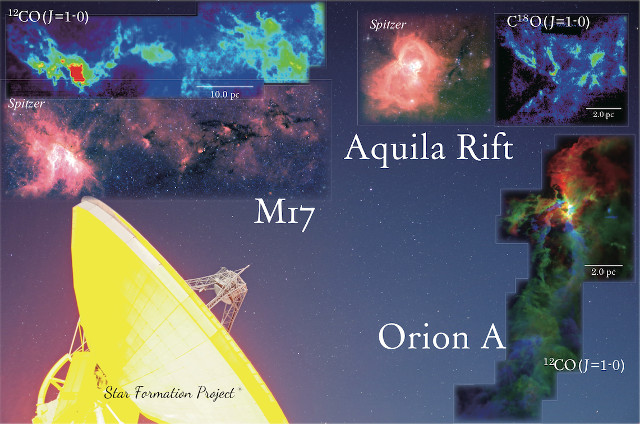
An article published in the journal “Publications of the Astronomical Society of Japan” reports the mapping of three interstellar clouds: Orion A, Aquila Rift, and M17. A team of researchers led by Professor Fumitaka Nakamura of the National Astronomical Observatory of Japan (NAOJ) used the Nobeyama radio telescope and for Orion A also data from the CARMA radio telescope array archive to achieve this result. This is an investigation not surprisingly called the Star Formation Project because the three interestellar clouds studied are nurseries for new stars.
Star formation processes continue to be studied by astronomers at both theoretical level and through observations. Interstellar gas clouds are the nurseries in which stars are formed, but the large amount of gas present inside them filters the visible light. That means that instruments are needed capable of detecting the frequencies that can pass through that gas, such as radio waves.
Different radio telescopes can provide different results depending on their characteristics. The ALMA radio telescope is currently the most powerful in the world, but has limitations regarding the field of view, which is fine for small or very distant objects, and observation time. The Nobeyama radio telescope with a single 45-meter dish has characteristics that are excellent to study relatively close interstellar clouds such as Orion A (1,350 light years), Aquila Rift (1,422 light years) and M17 (6,849 light years). The new FOREST (FOur beam REceiver System on the 45-m Telescope) instruments was used for this project.
The image (courtesy NAOJ. All rights reserved) contains a montage with the carbon monoxide emission lines in the three interstellar clouds examined in this project, Orion A, Aquila Rift and M17, and the Nobeyama radio telescope.
The Orion A interstellar cloud has already been the subject of various research precisely because in astronomical terms it’s practically in the neighborhood. Among the instruments used to study it in the past years there was the CARMA (Combined Array for Research in Millimeter-wave Astronomy) radio telescope array, unique because it was made up of 23 heterogeneous antennas: 6 of 10.4 meters in diameter, 9 of 6.1 meters in diameter, and 8 of 3.5 meters in diameter. CARMA ceased operations in 2015, but the archives of the observations made since 2006 keep on being useful.
The CARMA-NRO Orion Survey had already combined the data of CARMA with those of the Nobeyama radio telescope with results published in “The Astrophysical Journal Supplement Series” in May 2018. The new map of the Star Formation Project is the most detailed ever, with a resolution of about 3,200 times the average distance between Earth and Sun.
Each new investigation of this type offers new details on these star formation nurseries that help to better understand the processes that lead to the birth of new stars. New studies can combine data obtained in different investigations and possibly conduct follow-up observations of objects that astronomers consider particularly interesting.
