An article published in “The Astrophysical Journal Letters” reports the observation of jets of energetic particles coming from a supermassive black hole interacting with clouds of gas around them in the quasar MG J0414+0534, about 11 billion light years away. A team of researchers used the ALMA radio telescope to observe that quasar, but its details were detected thanks to a gravitational lensing effect generated by a galaxy between the quasar and the Earth. The interaction between jets and clouds suggests that the quasar’s radio activity is at an early stage and therefore useful to better understand the early stages of evolution of the galaxies that host a quasar in the early universe.
The study of primordial galaxies helps to understand the processes that led to their formation and evolution. It’s not at all easy because observing such galaxies means that they’re very distant, over 10 billion light years. Instruments such as the ALMA (Atacama Large Millimeter/submillimeter Array) radio telescope, inaugurated in March 2013, allow to observe distant objects, but even with its power and sensitivity it’s difficult to detect details such as the interaction between jets of ionized materials and gas clouds around a quasar. Luckily, in the case of the quasar MG J0414+0534 there’s a galaxy in the middle that acts as a gravitational lens with its gravity force magnifying the quasar’s image.
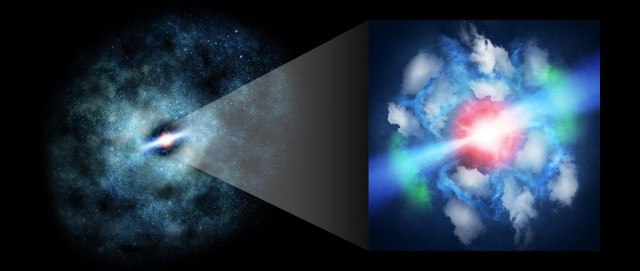
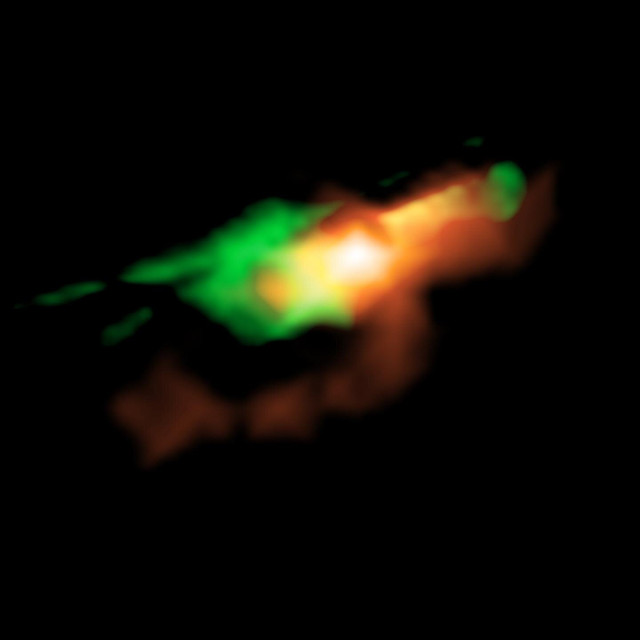
The gravitational lensing effect generates a distortion in the image of the quasar MG J0414+0534 that is observed by the ALMA radio telescope, but it’s possible to reconstruct its real shape. The top image (Courtesy ALMA (ESO/NAOJ/NRAO), K. T. Inoue et al.) shows the result of that process. Dust and ionized gas emissions around the quasar are shown in red. Carbon monoxide gas emissions are shown in green, with a bipolar structure along the jets. The bottom image (Courtesy Kindai University) shows an artist’s concept of the galaxy studied on the left with a zoom of the quasar on the right where it’s possible to better see its jets interacting with the gas clouds around it.
The observations of the quasar MG J0414+0534 showed the jets of ionized materials ejected at very high speeds from the supermassive black hole that powers the quasar. In some nearby galaxies, jets sweep away clouds of gas, causing a suppression of star formation. The influence of supermassive black holes on the galaxies that host them and in particular on star formation is a problem studied by astronomers, and studying the interaction between jets and clouds throughout the history of the universe is crucial to understand the various processes in act. In this case, it was possible to study the process in its early stages in a galaxy about 11 billion light years away which we see as it was when the universe was still young.
With the help of the gravitational lensing effect, the ALMA radio telescope allowed the researchers to discover that the clouds around the jets coming from the supermassive black hole are moving at speeds that can reach 600 km/s, showing clear evidence that there are impacts with the gas. Another discovery is that the size of the gas clouds and the jets themselves are much smaller than those typical of a galaxy of that age. For this reason, the researchers believe they observed one of the very early stages of jet evolution, which could mean that the jets were launched a few tens of thousands of years earlier.
Professor Kaiki Inoue of Kindai University, Japan, lead author of the article, explained that the quasar MG J0414+0534 is an excellent example because of the young jets. Together with his colleagues, he discovered evidence that there’s a remarkable interaction between the jets and the clouds even in the very early stages of the evolution of the jets. For this reason the researchers think that their discovery opens the way to a better understanding of the evolutionary processes of the galaxies in the early universe.
The luck of having a gravitational lens that allowed to observe details of the quasar MG J0414+0534 brought new information on the development of supermassive black holes, especially when the universe was young. Follow-up observations could capture more details to better understand the influence that these extreme objects have on the galaxies that host them. The studies mainly concern when the activity of supermassive black holes can inhibit star formation and when it can stimulate it.