
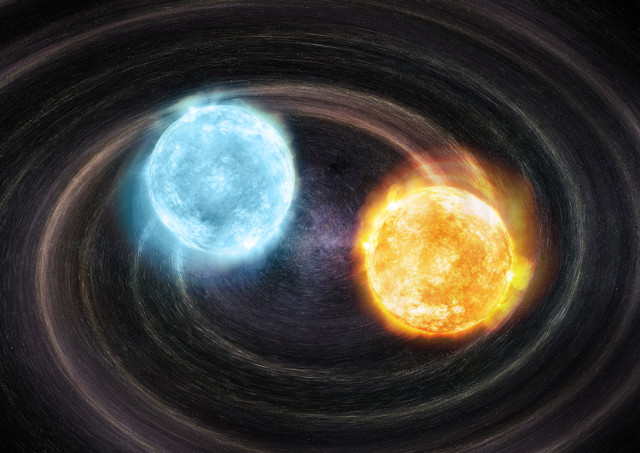
An article to be published in the “Astrophysical Journal Letters” reports the discovery of a binary system formed by two white dwarfs with helium cores orbiting each other in 1201 seconds, one of the shortest orbital periods known in binary systems. A team of researchers led by astronomer Warren Brown of the Center for Astrophysics | Harvard & Smithsonian (Cfa) used data collected by ESA’s Gaia space probe and the Sloan Digital Sky Survey (SDSS) of the pair cataloged as SDSS J232230.20+050942.06, or simply J2322+0509, conducting follow-up observations with others instruments to examine their characteristics. It’s a possible source of gravitational that will be detected by the LISA sallite currently being designed by ESA.
When stars with a mass less than half the Sun’s reach the end of their life, they degenerate when their core is made up of helium whereas stars of higher mass have cores that reach temperatures high enough to trigger the fusion of helium into carbon. Red dwarfs are the most common stars in the universe, but they’re also the ones with the longest life because they consume their hydrogen slowly. There are ancient red dwarfs that have already become white dwarfs, and J2322+0509 is a pair of this type, which is probably common.
Warren Brown’s team searched for small-mass pairs, the type expected to be made of helium, looking in ESA’s Gaia space probe Data Release 2, published on April 25, 2018, and the Sloan Digital Sky Survey (SDSS) data. The J2322+0509 pair turned out to be an interesting candidate and was the object of follow-up observations. Spectroscopic data of J2322+0509 were collected using the MMT telescope at the Fred Lawrence Whipple Observatory in Amado, Arizona, the Magellan Baade telescope at the Las Campanas Observatory in Chile, and the Gemini-Nord telescope in Mauna Kea, Hawaii.
The results of the analyzes of the spectroscopic data for J2322+0509 indicate that it’s a spectroscopic binary, which means that it requires spectroscopes to distinguish the two stars because even the most powerful optical telescopes can’t distinguish them. Other analyzes indicate that they’re about 250 light years away from Earth and that the two white dwarfs have masses of about 0.27 and 0.24 solar masses.
The orbital period of the J2322+0509 pair is really short with its 1201 seconds. This means that their orbit is unstable and in six or seven million years they will merge into a massive white dwarf. The pair is oriented towards the Earth face-on, but the consequence is that the gravitational waves it emits are 2.5 times stronger than if it were oriented edge-on. For this reason, it’s an interesting target for the LISA (Laser Interferometer Space Antenna) J2322+0509, ESA’s space gravitational observatory scheduled to be launched in 2034. LISA aims to bring gravitational wave astronomy to a new level.
