
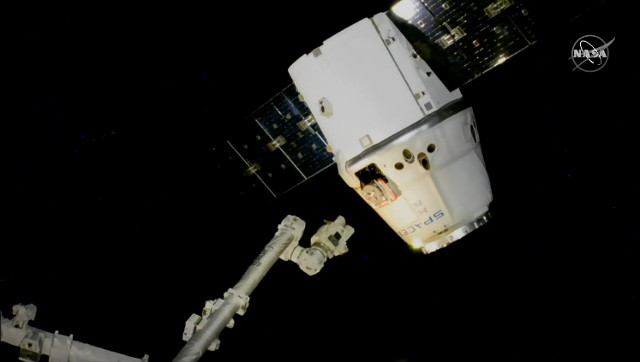
A few hours ago the SpaceX Dragon spacecraft ended its CRS-20 (Cargo Resupply Service 20) mission for NASA splashing down smoothly in the Pacific Ocean a bit more than 800 kilometers (about 500 miles) off the coast of California. The Dragon left the International Space Station yesterday. For SpaceX, this is the conclusion of the first contract with NASA to transport resupplies to the Station with the first version of the Dragon cargo spacecraft.
Shortly after landing, SpaceX boats went to retrieve the Dragon to transport it to the coast. The cargo brought back to Earth will be delivered to NASA soon, probably tomorrow. The Dragon spacecraft reached the International Space Station on March 9, 2020.
The Dragon spacecraft brought back to Earth about 2,000 kg (more than 4,000 lbs) of mixed cargo between the pressurized and the non-pressurized section that include various scientific experiments and biological samples. Part of the samples are contained in the freezers because they need to be kept at low temperatures.
SpaceX is the only American company that has a spacecraft capable of bringing intact cargo back to Earth so the Dragon missions are really important for NASA. Samples produced during many of the experiments conducted on the International Space Station may require in-depth analyzes possible only in specialized laboratories on Earth.
Medical research, other biological research and experiments of other types are conducted on the Station. When they need to bring something back to Earth a little cargo can be transported together with the astronauts on the Soyuz spacecraft but their total volume requires a cargo spacecraft that can bring them back to Earth.
The next resupply mission for the Dragon space cargo ship could begin in October 2020, but more than ever the dates are approximate. Many launches have been postponed due to the difficulty in ensuring the safety of the personnel who manage the transport of satellites and various spacecraft as well as the personnel in the control centers. Some launches will still be conducted because they’re of special importance, and the International Space Station is very important. The Station crew has a great stock of food, water and oxygen, but scientific research must continue, which requires sending new experiments and instruments and the return to Earth of experiments and samples.
Medical considerations aside, the next resupply mission will be the first of the new contract and will use the Dragon 2 cargo spacecraft. According to plans, the manned version, the Crew Dragon, should be the first to accomplish a real mission, perhaps already in May. The era of the Dragon’s first version is over after almost ten years of development to make room for a version that’s improved also thanks to that experience. It also has greater possibilities of reuse, that at least initially will concern the cargo version and not the manned version.

Permalink