
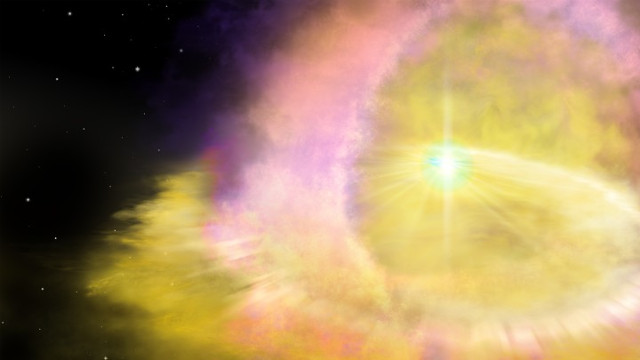
An article published in the journal “Nature Astronomy” reports a study on the supernova cataloged as SN2016aps, which was found to be at least twice as bright and probably much more massive than any other registered supernova. A team of astronomers led by Dr. Matt Nicholl of the British University of Birmingham observed the evolution of the supernova for about two years until it faded to 1% of its peak brightness. The conclusion is that the initial mass of the exploded star might have been even more than 100 times the Sun’s and this suggests that it was a very rare type called a pulsational pair-instability supernova.
Supernovae are the most violent type of death for a star with an explosion that releases a huge amount of energy in a short time and if close enough it can be visible to the naked eye from Earth during the day. This end occurs for stars much more massive than the Sun, typically with a mass between 8 and 15 times the Sun’s, but there are truly giant stars that can be much more massive. It seems the case of the one that originated SN2016aps, a superluminous supernova.
On February 22, 2016, the Panoramic Survey Telescope and Rapid Response System (Pan-STARRS) project located a supernova that was cataloged as SN2016aps. Subsequently, other space and ground-based telescopes were used to study its evolution collecting a considerable amount of data useful for Dr. Matt Nicholl’s team as well. The exploded star was about 3.6 billion light-years away, too far away to be seen by the naked eye from Earth despite a brightness that was unusual even for this type of explosion.
The data allowed to estimate the initial mass of the exploded star, which could be even more than 100 times the Sun’s, truly gigantic. Very massive stars go through a pulsing phase before exploding, ejecting a sort of large shell of gas made up of these stars’ outer layers. The process is called pair-instability, but this seems to be a particular case, and it’s possible that two massive stars merged before the supernova, generating a very rare type called pulsational pair-instability supernova.
The researchers found another anomaly in their study of the supernova SN2016aps. Spectroscopic detections showed that the ejected gas is mainly hydrogen, but such a massive star is supposed to lose it through solar wind long before the pulsation process begins. The merger of two stars could explain this oddity because the less massive star could still have a certain amount of hydrogen.
Superluminous supernovae are very rare, and SN2016aps is exceptional even for that extreme type of event. The energy emitted was hundreds of times higher than that of a typical supernova, a cosmic cataclysm that’s very interesting for astronomers. Increasingly powerful instruments will be able to detect such rare events even if they occur billions of light-years from Earth.
