
An article published in “The Astrophysical Journal” reports the discovery of the most energetic outflow from a distant quasar, to be precise from the one classified as SDSS J135246.37+423923.5. A team of researchers used the Gemini North telescope, Hawaii, to conduct the observations they needed and a new computer modeling system had to be used to interpret what was called an extragalactic storm hidden in plain sight for 15 years. The outflow, a sort of cosmic wind, travels at a speed that is almost 13% of the speed of light with a strong impact on the star formation in the galaxy hosting the quasar.
About 10 billion light-years away from Earth, the quasar SDSS J135246.37+423923.5 is powered by a supermassive black hole whose mass was estimated at about 8.6 billion times the Sun’s, about 2,000 times that of the supermassive black hole at the center of the Milky Way. It’s a really huge mass even for such an extreme object, and its very strong gravity heats the materials that orbit it in considerable amounts to the point that they emit electromagnetic radiation so intense that they’re visible even from that distance.
The Gemini North telescope, Hawaii, is one of the two telescopes of the Gemini Observatory, run by the National Optical-Infrared Astronomy Research Laboratory (NOIRLab) of the USA’s National Science Foundation (NSF). The Gemini North is equipped with the Gemini Near-Infrared Spectrograph (GNIRS) instrument, which allowed to obtain a clear view of the quasar SDSS J135246.37+423923.5, an operation that was made difficult by the outflow itself, which is so thick that it filtered wavelengths like those of visible light.
Infrared spectrographic observations were combined with a new computer model that allowed to interpret the data collected providing the surprising speed of the outflow. About 38,000 kps make up about 13% of the speed of light, a very high speed for that sort of energetic wind. Astronomer Sarah Gallagher of Western University, Canada, who directed the observations, explained that high-speed quasar winds have been observed in the past, but were thin while this one sweeps away a significant amount of mass at incredible speeds, to the point that the researchers don’t know how the quasar can launch something so substantial.
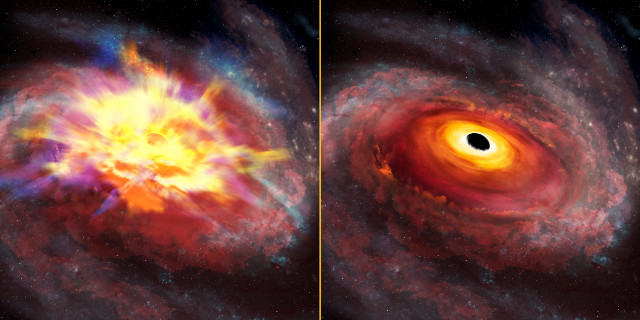
The image (International Gemini Observatory/NOIRLab/NSF/AURA/P. Marenfeld) shows on the left an artist’s concept of the central portion of the galaxy that hosts the quasar SDSS J135246.37+423923.5 seen at optical wavelengths. Thick winds obscure our view of the outflow coming from its nucleus. On the right the same artist’s concept illustrates the view at infrared wavelengths, the ones detected by the GNIRS instrument. In that case, the thick outflow is transparent offering a clear view of the quasar. The infrared spectrum also shows the redshift, which made it possible to calculate the outflow’s velocity.
Hyunseop (Joseph) Choi of the University of Oklahoma, first author of the article, explained that we don’t know how many extraordinary objects like SDSS J135246.37+423923.5 exist in quasar catalogs because automated software generally identifies them by strong emissions or blue color, two properties that the quasar studied by his team lack. There may be other quasars with very powerful outflows hidden in various surveys.
This research is important because the outflow generated by the quasar SDSS J135246.37+423923.5 is so powerful that it sweeps away the gas in the clouds that are nurseries for new stars, inhibiting their formation. That’s a strong influence on the galaxy that hosts the quasar. The influence of supermassive black holes on their galaxies is an important research topic in recent years.
