
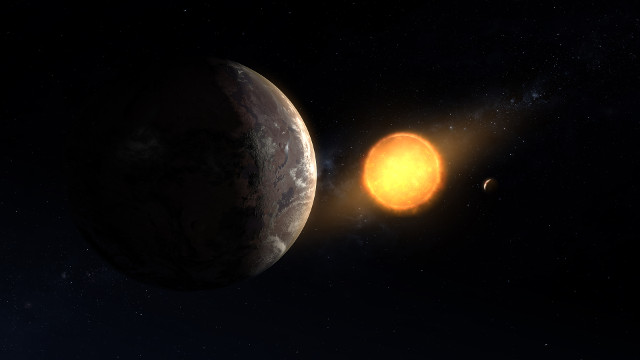
An article published in “The Astrophysical Journal Letters” reports the discovery of the exoplanet Kepler-1649c, which has a size very similar to the Earth’s and orbits in its system’s habitable zone. A team of researchers led by Andrew Vanderburg of the University of Texas, Austin, reanalyzed data collected by NASA’s Kepler space telescope and subsequently analyzed using software written for that task. Initially, only one exoplanet was confirmed in that system while another candidate was discarded. A human verification led to the confirmation of the planet that was cataloged as Kepler-1649c. The two planets’ orbital characteristics suggest the possibility that a third one exists, even if for now the researchers haven’t been able to find any traces of it.
The mission of the Kepler space telescope ended on October 30, 2018, leaving a wealth of a few thousand confirmed exoplanets and many candidates yet to be verified. The huge amount of data is analyzed by automatic systems that among other things discard candidates exoplanets when they’re considered false positives because some cosmic phenomenon generated a trace similar to the transit of an exoplanet between its star and Kepler. These systems were perfected over the years, however, they’re not perfect, so a candidate might have been mistakenly discarded. For this reason, the Kepler mission team formed the False Positive Working Group (FPWG) to double-check them and in the case of the candidate that was cataloged as KOI 3138.02, the human check revealed the existence of an exoplanet which is also very interesting.
The Kepler-1649 system, designated as KOI 3138 where KOI stands for “Kepler Object of Interest” in the mission, was observed several times by the Kepler space telescope between 2010 and 2013. About 300 light-years away from Earth, the star is a red dwarf with a size of about a quarter of the Sun’s. Various traces of transits in front of it led to the creation of two exoplanet candidates, but only Kepler-1649b was confirmed. That’s a planet that was compared to Venus because it’s slightly larger than Earth and Venus, but with a year lasting about 8.7 Earth days it receives a remarkable amount of energy even if its star is small.
The discovery that there’s a second exoplanet in that system after all turned out to be very interesting because Kepler-1649c is very similar in size to the Earth, and with a year lasting 19.5 Earth days it receives an amount of energy from its star that is about 75% of what the Earth receives from the Sun. Basically, if Kepler-1649c has an atmosphere similar to the Earth’s it could be cold but habitable.
The presence of two rocky planets in the Kepler-1649 system is particularly exciting for Andrew Vandenburg not only because the one discarded by mistake is in its habitable zone, but also for the possible interaction with its neighbor. Between two or more planets what’s called orbital resonance may exist, and in this case 9 years of Kepler-1649b almost exactly equal 4 years of Kepler-1649c. The 9/4 ratio is unusual, and the researchers suspect that a third planet may orbit between those two creating more common resonances such as 3/2. However, at least for now the researchers found no traces of a third planet, but it could have escaped the observations if it’s smaller, like Mars or Mercury to continue the similarities with the solar system’s planets, or have a tilted orbit, so it never transited between its star and Kepler.
The discovery of the exoplanet Kepler-1649c led to new comments on the alleged Earth’s twin. The bottom image (NASA/Ames Research Center/Daniel Rutter) shows its almost identical sizes, but otherwise we know very little about this exoplanet. Follow-up observations will be needed to try to understand if Kepler-1649c has an atmosphere, and if that’s the case, if it’s similar to the Earth’s. Its star is small, but red dwarfs can be very active, devastating their planets’ atmospheres with powerful flares. Kepler-1649c joins the group of some exoplanets with sizes close to the Earth’s in their system’s habitable zone, but there’s still a lot of work to make sure that one of them can actually host life forms similar to the Earth’s.

