
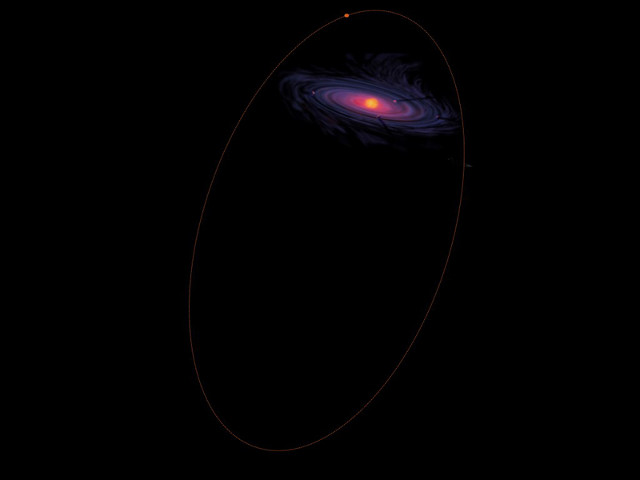
An article published in the journal “Monthly Notices of the Royal Astronomical Society” reports evidence of the interstellar origin of some asteroids of the centaur family and two transneptunian objects. Astronomer Fathi Namouni of the University of the Côte d’Azur in Nice, France, and his colleague Helena Morais of the Universidade Estadual Paulista, Brazil, used computer simulations to reconstruct the orbits of those asteroids backwards, concluding that they’re likely interstellar asteroids captured from another system that could have been much closer when the Sun and the stars born with it had just formed.
The discovery of interstellar objects that are passing through the solar system increased the interest in asteroids and comets in recent years. However, astronomers Fathi Namouni and Helena Morais had already been working on this type of research for quite some time, so much so that an article also published in the journal “Monthly Notices of the Royal Astronomical Society” in May 2018 reported evidence that the asteroid 2015 BZ509, later named Kaʻepaokaʻawela, probably had an interstellar origin. Their work continued on other asteroids and the interesting thing is that they’re in stable orbits, unlike the asteroid 1I/’Oumuamua and the comet 2I/Borisov, which are moving away from the Sun in trajectories that will take them out of the system solar.
The asteroid 2015 BZ509 has an orbit very close to that of the planet Jupiter but retrograde. The asteroids examined in this new research have different types of orbits, almost all with an inclination with respect to the ecliptic plane of over 60°. The exception is the asteroid Chiron, a centaur that, among other things, approaching the Sun showed a coma typical of a comet. Centaurs constitute a family of asteroids whose point closest to the Sun falls within the orbits of the gas giants Jupiter, Saturn, Uranus, and Neptune. 17 centaurs were picked as candidates for this research because they showed abnormal orbital characteristics. Two transneptunian asteroids were added whose orbits are more distant than Neptune’s.
Previous studies based on computer simulations suggested that those asteroids formed in the planetesimals disk that existed in the very early stages of the solar system’s formation. These are simulations that started from that disk and then went on in time, the opposite of what Fathi Namouni and Helena Morais did as they generated simulations that go back in time starting from today’s orbits of the asteroids studied. The result is that reaching 4.5 billion years ago, the orbits of the 19 asteroids examined are not part of the disk from which the solar system was born and indeed were far from them.
The image (NASA) shows an illustration of the orbit that a centaur studied in this research had 4.5 billion years ago according to the simulations in relation to the protoplanetary disk from which the solar system was formed. The asteroid had an orbit around the Sun far from the disk and more or less perpendicular to it.
Like the asteroid 2015 BZ509, the 19 examined in this new research may have come from a star system that was close at the time, in a cluster in which the Sun and other stars formed and then moved away from each other. At the time it was much easier for asteroids to be ejected from a star system by anomalous gravitational pushes and captured by neighboring systems.
More research will be needed to verify Fathi Namouni and Helena Morais’s thesis, also to understand why previous simulations provided very different results. Simulations become more and more sophisticated in time, but that’s not enough to say that the most recent ones are always correct. The possibility that a group of asteroids came from another star system is very interesting and stimulates research even more.
