
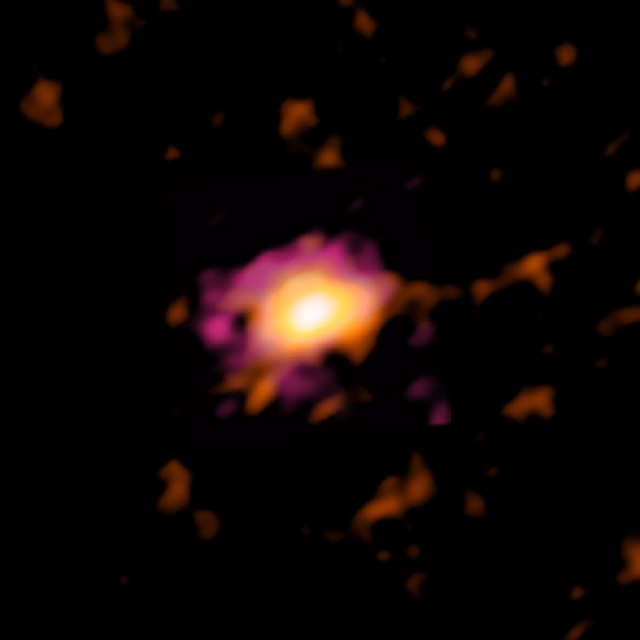
An article published in the journal “Nature” reports a study on the galaxy nicknamed Wolfe Disk that shows that it formed very early, to the point that it already had the shape of a disk galaxy about 1.5 billion years after the Big Bang. A team of researchers used the ALMA radio telescope to study this galaxy and find evidence of its characteristics that make it the oldest with a rotating disk found so far. Its existence so early in the history of the universe poses a problem for the current galactic formation models.
The galaxy officially designated as DLA0817g or ALMA J081740.86+135138.2 was discovered in 2017 by a team led by Marcel Neeleman of the Planck Institute for Astronomy in Heidelberg, Germany, using the ALMA (Atacama Large Millimeter/submillimeter Array) radio telescope, inaugurated in March 2013. The nickname Wolfe Disk was given after astronomer Arthur M. Wolfe, who passed away in 2014.
Some members of the team that discovered Wolfe Disk, again led by Marcel Neeleman, continued the research using ALMA again. The top image (ALMA (ESO/NAOJ/NRAO), M. Neeleman; NRAO/AUI/NSF, S. Dagnello) shows an image of Wolfe Disk seen by ALMA. The addition of observations with the VLA (Very Large Array) and the Hubble Space Telescope allowed to detect the large amount of molecular clouds in which massive stars were born at a truly remarkable rate, ten times higher than that of the Milky Way. The image below (ALMA (ESO/NAOJ/NRAO), M. Neeleman; NRAO/AUI/NSF, S. Dagnello; NASA/ESA Hubble) shows images of Wolfe Disk in a combined view between Hubble and VLA on the left and between Hubble and ALMA on the right.

In the past, primordial rotating disk and gas-rich galaxies have been found, but the ones with a mass comparable to Wolfe Disk’s were the result of galaxy mergers and this was visible in their shapes distorted by those processes. Wolfe Disk shows a regular rotating disk, a shape that, according to current galactic formation models, should have been reached about 6 billion years after the Big Bang.
J. Xavier Prochaska of the University of California, Santa Cruz, another of the team members that discovered Wolfe Disk and the one that conducted the most recent study on it, explained that he and his colleagues believe that this galaxy grew especially through a constant accretion of cold gas. One of the questions that remain is how to assemble such a large mass of gas while keeping a relatively stable rotating disk.
Galaxies like Wolfe Disk might be common even in the early universe. If that were confirmed by studies of other galaxies dating back to a near era, this would mean that something important is still missing in the current models of galactic formation. Instruments like ALMA are excellent for this type of study and allow to expand our knowledge, leading to improvements in our cosmological models.

Permalink