
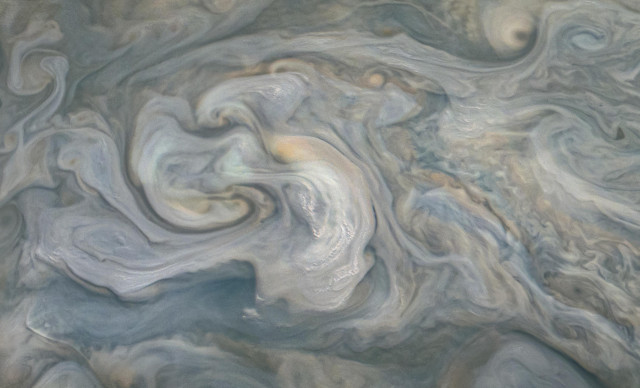
Three articles, one published in the journal “Nature” and two published in the journal “Geophysical Research: Planets”, report various aspects of research on the clouds of the planet Jupiter. Three teams of researchers with various members in common, coordinated by the French CNRS’s Laboratoire Lagrange and NASA’s JPL, used data collected by the Juno space probe to analyze various aspects of the role of water in the violent storms in the Jovian atmosphere. Lightning strikes originate in a solution of water and ammonia, substances that can form a sort of hailstones, nicknamed mushballs by the researchers, which play a key role in the atmospheric dynamics of this gas planet.
We’re used to the crucial role of water in weather phenomena on Earth, particularly about thunderstorms and lightning. It may seem strange that water plays an important role in the atmosphere of a gas giant planet, which is made up mostly of hydrogen, but since the dawn of the solar system, comets have been striking Jupiter, carrying significant amounts of water. In Jupiter’s atmosphere, so turbulent that it has a giant storm like the Great Red Spot, there are phenomena researchers are still discovering. The detections of the Juno space probe, which entered the planet’s orbit on July 5, 2016, are helping to solve these mysteries.
The presence of lightning on Jupiter is far from new since they were detected by various space probes: by Galileo during its study focused on the planet, by Voyager 1 during its tour of the solar system, and even by New Horizons on its way to the Kuiper Belt. However, a sophisticated instrument such as the Juno Stellar Reference Unit was needed, designed to detect even dim light sources, to obtain a portrait of the phenomena taking place in the Jovian atmosphere sufficient to understand the role of water and that of ammonia.
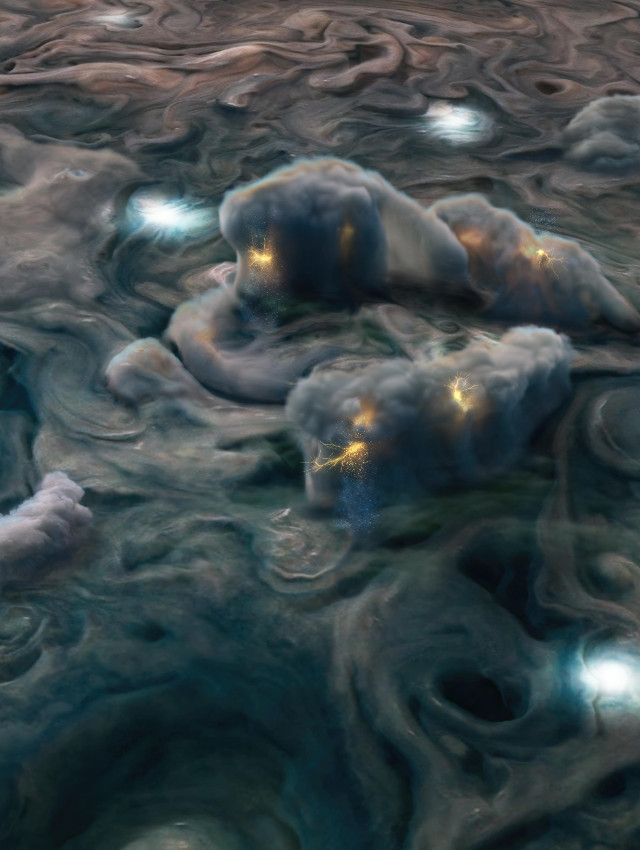
The importance of ammonia is due to its antifreeze effect on water, which can remain liquid when mixed in a solution made up of two-thirds of water and one-third of ammonia down to temperatures of -100° Celsius. The two compounds mix in the Jovian atmosphere’s upper layers, and the resulting droplets collide with the water-only ice crystals, generating electric charges and shallow lightning.
The weight of the hail formed by water and ammonia after growing causes it to fall into the atmosphere’s lower layers, where they evaporate. This explains why the Juno space probe’s Microwave Radiometer instrument detected very little ammonia in the upper layers as it becomes invisible after mixing with water.
These researches provided explanations for truly exotic weather phenomena since some processes don’t take place on Earth. They help to understand what happens in the atmosphere of a gas planet, and this means Uranus and Neptune but also exoplanets of that kind.

Permalink