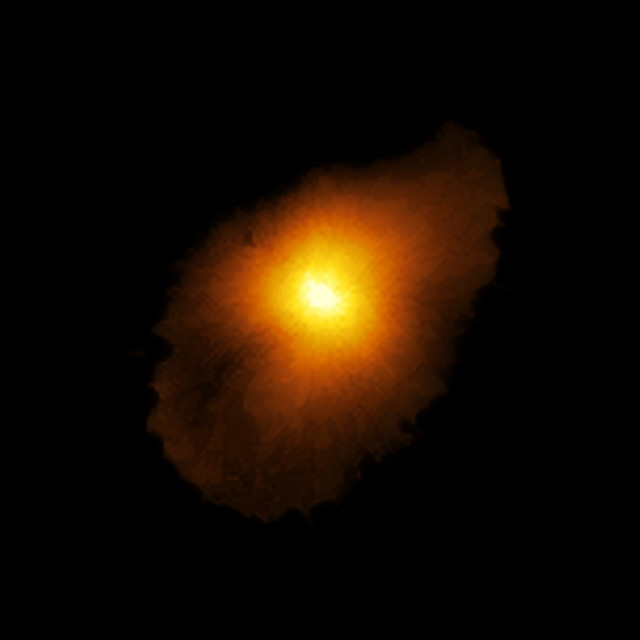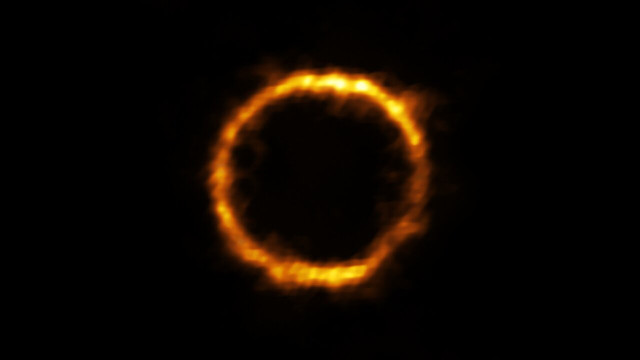
An article (link to the file in PDF format) published in the journal “Nature” reports the study of a primordial galaxy we see as it was when the universe was 1.4 billion years old and resembles the Milky Way, a surprise because we see it when it was very young, and according to current theories should be turbulent and unstable. A team of researchers led by Francesca Rizzo, a Ph.D. student at the Max Planck Institute for Astrophysics in Germany, used the ALMA radio telescope to observe this galaxy, cataloged as SPT-S J041839-4751.9, or simply SPT0418-47. Help came from a gravitational lens that magnified the image, allowing to see the similarities with the Milky Way and gather new information on the early stages of galaxy evolution.
According to current models, in a young galaxy, there are many massive stars that consume their hydrogen at a frenzied rate leading to many supernovae, and galactic mergers are normal. The consequence is that astronomers expect to observe chaos and instability in a young galaxy, but that’s not what they found in the one cataloged as SPT0418-47. Its discovery was announced in 2011 as part of the South Pole Telescope Survey and was already observed with the ALMA radio telescope in 2017.
At distances greater than 10 billion light-years, even the most powerful telescopes struggle to detect a galaxy’s faint light. Francesca Rizzo’s team used the Atacama Large Millimeter/submillimeter Array (ALMA) radio telescope, inaugurated in March 2013, and exploited the gravitational lensing effect generated by the powerful gravity of a galaxy between us and SPT0418-47. The result is that the image that reaches us after 12 billion years is magnified but also very distorted, in the shape of an almost perfect ring of light. The researchers computer-processed that image to reconstruct the true appearance of SPT0418-47, obtaining the surprise of a galaxy that already shows features similar to the Milky Way.
The galaxy SPT0418-47 has a high star formation rate, just as expected due to its age, but at the same time, it already has orderly structures that astronomers don’t expect to find in such a young galaxy. There’s a rotating disk and a bulge at its center made up of a group of stars around the galactic core. It’s the oldest bulge observed in a galaxy so far.
One difference between the SPT0418-47 galaxy and the Milky Way is the apparent lack of spiral arms. The researchers believe that over time it evolved not into a spiral galaxy but an elliptical galaxy. This can be verified in a very long time if the galaxy that acts as a gravitational lens will continue to be in the right place or if other instruments will allow to observe SPT0418-47 directly. Meanwhile, the search for primordial galaxies continues to understand if these galaxies where there’s already a certain order are common. One is the galaxy called Wolfe Disk.