
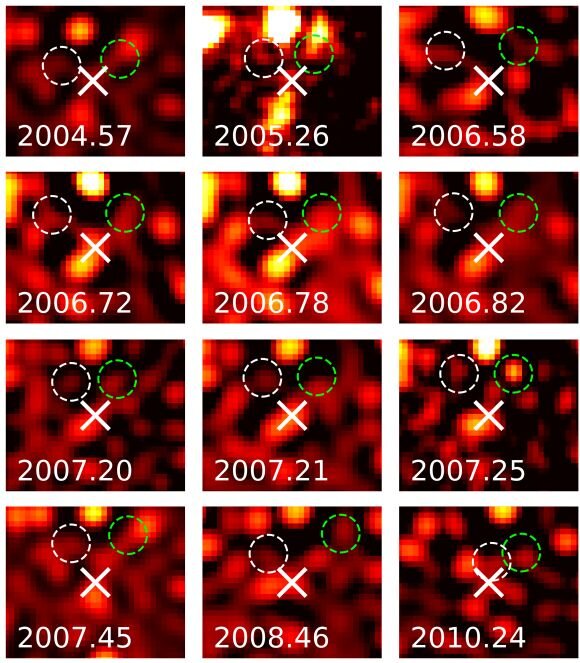
Two articles – available here and here – published in “The Astrophysical Journal” report research on stars orbiting Sagittarius A*, or simply Sgr A*, the supermassive black hole at the center of the Milky Way, including the ones that reach the highest speed, S62 and S4714, and the one that goes through the orbit in the shortest time, S4711 in 7.6 Earth years. A team of researchers from the German University of Cologne led by Florian Peißker used observations made with the NACO and SINFONI instruments mounted on ESO’s VLT in Chile to track S62’s orbit. With the addition of two more researchers, the team also tracked the orbits of other stars in that area.
The environment around Sgr A* is extreme due to the very powerful gravity of an object that has a mass estimated to be over 4 million times the Sun’s. For this reason, the observations of the stars orbiting this supermassive black hole are very interesting. One of them, cataloged as S2, has been under observation for almost thirty years with the use of ESO telescopes.
In recent years it’s been possible to verify relativistic effects, phenomena predicted by Albert Einstein’s theory of general relativity caused precisely by the passage of the star S2 within the gravitational field of Sgr A* at very high speeds. Thanks also to instruments such as NACO and SINFONI, installed on the VLT (Very Large Telescope), in recent years more stars have been discovered that orbit the supermassive black hole even faster getting closer to it.
One of the two articles was written by Florian Peißker together with his colleagues Andreas Eckart and Marzieh Parsa, and is focused on the star S62. Its year is shorter than S2’s and lasts about 9.9 Earth years, and its mass is estimated to be about twice the Sun’s. It approaches up to 2.4 billion kilometers from Sgr A* reaching a speed of about 21,000 km/s, more than 8% of the speed of light. At that speed, the relativistic effects are relevant, and it was calculated that one hour on S62 would last about 100 Earth minutes.
Over the years, more stars have been discovered and observed with interesting results described in the other article written with the collaboration of Michal Zajacek and Basel Ali as well. S4711 is a massive blue star with an estimated age of around 150 million years. It approaches up to about 21.5 billion kilometers from Sgr A*, much farther than S62, but its year lasts less, about 7.6 Earth years. S4714 is the star that reaches the highest speed in a peak of 24,000 km/s when it reaches 1.9 billion kilometers from Sgr A*. However, its orbit is very eccentric and at the farthest point, it reaches about 250 billion kilometers from Sgr A*, so its year lasts about 12 Earth years.
Florian Peißker explained that the star S4714 is interesting also because it could be a squeezar. That’s a type of star that has a very eccentric orbit around a supermassive black hole whose temperature changes considerably due to the differences in the gravitational tide effects between the points closest and farthest from the black hole. S4711 is also an interesting squeezar candidate.
The various stars that orbit Sgr A* are offering interesting information for the various consequences of their interaction with the supermassive black hole Sgr A*. For this reason, they will keep on being studied and researchers expect to find more or them.
