
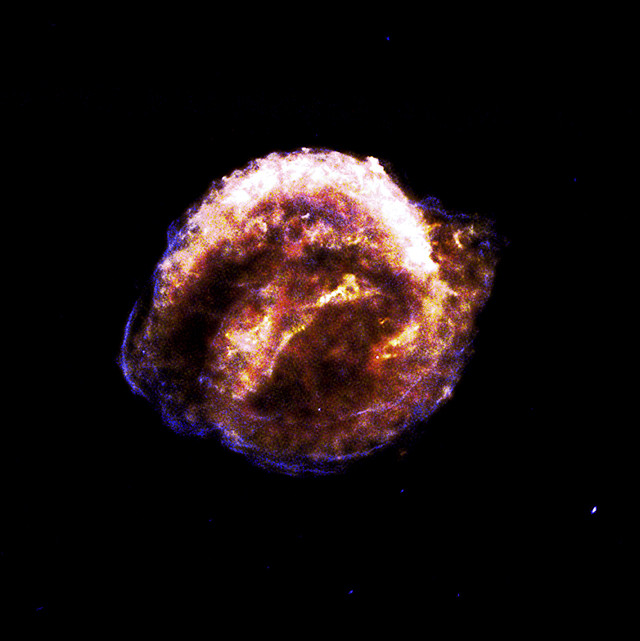
An article published in “The Astrophysical Journal” reports a study on the remnants of the so-called Kepler supernova, formally cataloged as SN 1604. A team of researchers led by Matthew Millard of the University of Texas at Arlington used data collected with NASA’s Chandra X-ray Observatory to observe materials moving away from the blast area. 15 “knots” of materials were observed in different periods thanks to their X-ray emissions, and one of them was found to have a speed higher than 37 million km/h, more than twice the average speed, while the shockwave is expanding at around 27 million km/h.
Kepler supernova occurred about 20,000 light-years from Earth, therefore inside the Milky Way, and was visible from the Earth with the naked eye between 1604 and 1606. The nickname is due to the fact that the astronomer Kepler was the one who studied it at length and published an essay about it entitled “De Stella nova in pede Serpentarii“. By studying the remnants with the instruments astronomers have at their disposal today, it was possible to establish that it was a type Ia supernova, a type that occurs when a white dwarf steals materials from a companion until it reaches a critical mass that triggers its explosion.
Matthew Millard’s team studied Kepler supernova’s remnants using observations carried out over various periods using the Chandra X-ray Observatory. The electromagnetic spectra detected in 2016 were analyzed to determine their Doppler effect, which alters their wavelength allowing to calculate the speed of the objects that emitted them. Another speed calculation was conducted by measuring the change in position of the 15 knots of materials that were examined in 2000, 2004, 2006, and 2014, the years of the observations made with Chandra. The result is that the average speed of the knots is almost 17 million km/h, but the fastest knot reaches 37 million km/h while the shockwave is expanding at a speed of about 27 million km/h.
These are extremely high speeds four centuries after the supernova, but they’re not a surprise. A research published in August 2017 in “The Astrophysical Journal” already reported very high estimates for Kepler supernova’s debris. However, that research was based on data collected by different Chandra instruments, instead the new research is based on data collected by the High-Energy Transmission Grating Spectrometer (HETGS) instrument, so the results are more accurate.
There’s no explanation for the very high speeds of Kepler supernova’s debris. One possibility is that it was a particularly powerful supernova. Another one is that the debris is clumpy, so the knots travel in low-density areas with little slowdown. That’s another reason for interest in these supernova remnants.
