
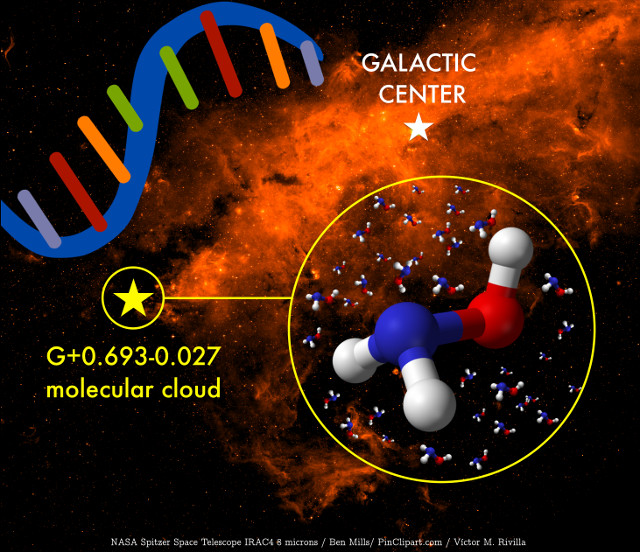
An article published in “The Astrophysical Journal Letters” reports the discovery of hydroxylamine, a precursor of RNA nucleotides, in the molecular cloud G+0.693-0.027, in the heart of the Milky Way. A team led by Víctor M. Rivilla, of the Centro de Astrobiología in Madrid and associated with the Italian National Institute of Astrophysics in Arcetri used the IRAM radio telescope to detect the chemical signature of hydroxylamine. Other molecules important in the formation of RNA and DNA were already detected in space, this is more evidence that at least part of life building blocks can somehow seed a newly formed planet bearing fruit where conditions are suitable.
RNA may have been the first nucleic acid formed on Earth, before DNA. Not all the passages that led to the birth of the first life forms have been reproduced, and some of them are still under study, leaving some doubts still. In these studies, chemistry and biochemistry experiments have increasingly gone hand in hand with radio astronomy observations that made it possible to detect the chemical signatures of molecules that form life building blocks for the type of life that developed on Earth. Molecular clouds, where conditions exist for the formation of new stars, are areas of space where astronomers look for these molecules to understand if the new planets that could form around young stars could be seeded.
One of the molecules that wasn’t detected in space yet is hydroxylamine, one of the precursors of RNA nucleotides. Using the IRAM radio telescope in Pico Veleta, Granada, Spain, astrochemist Víctor M. Rivilla’s team found this molecule in the molecular cloud G+0.693-0.027, about 30,000 light-years from Earth.
The image (Courtesy NASA Spitzer Space Telescope IRAC4 8 microns / Ben Mills / PinClipart.com / Víctor M. Rivilla (Madrid Astrobiology Center // INAF Arcetri)) shows the central area of the Milky Way in an image capture by NASA’s Spitzer space telescope. The star shows the area of the molecular cloud G+0.693-0.027, where hydroxylamine was found. Its molecule structure is reproduced in the large circle. Top left, the structure of an RNA fragment.
Now hydroxylamine is added to other prebiotic molecules that form in the interstellar medium and could spread over the planets that form even in the same molecular clouds. Knowing that this molecule may also be available for the birth of life forms helps to understand the processes that took place on the young Earth. This collaboration between biology and astronomy will continue, also offering insights into the search for life in the universe.
