
An article published in “The Astronomical Journal” reports the results of a study of the TOI-421 system, where two exoplanets were discovered following observations conducted by NASA’s TESS space telescope. A team of researchers led by Ilaria Carleo of Wesleyan University used various telescopes to conduct follow-up observations that confirmed the existence of the Neptunian exoplanet detected by TESS also discovering a radial velocity signal that led to the identification of a sub-Neptunian planet. Both are close to their star so they’re heated and their atmosphere is very large with a low density. In particular, the outer exoplanet is of the type that was called super puffy or cotton candy planet, difficult to explain for current models of atmospheric evolution.
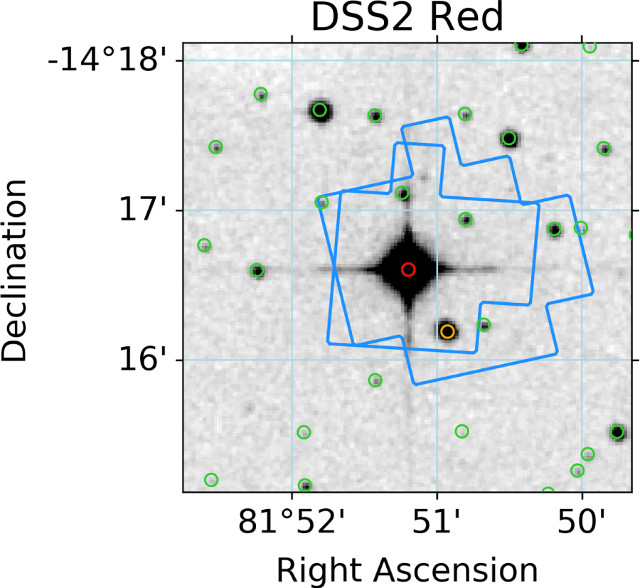
Launched on April 18, 2018, the TESS space telescope is finding new exoplanets. The star TOI-421, also known as BD-14 1137 or TIC 9498631, is smaller than the Sun and has a companion, a red dwarf that orbits the larger star at a distance that is approximately 2,200 times that of the Earth from the Sun. It was monitored between November 15, 2018, and January 7, 2019, leading to the identification of an exoplanet candidate. The image (courtesy Carleo et al. All rights reserved) shows the TOI-421 system in the DDS2 (Digitized Sky Survey 2) with the main star in the red circle in the center and its companion in the orange circle.
Ilaria Carleo’s team conducted a series of follow-up observations using ground-based telescopes to verify the candidate exoplanet and measure its characteristics. The result was positive and what was cataloged as TOI-421 b turned out to be a Neptunian with a mass of about 16.42 times the Earth’s for a radius that is just over 5 times the Earth’s and a year of the duration of almost exactly 16 Earth days.
The follow-up observations also detected a radial velocity signal, meaning the researchers found traces of a second exoplanet that was cataloged as TOI-421 c. The data indicate that it’s a sub-Neptunian with a mass that is about 7.17 times the Earth’s for a radius that is about 2.68 times the Earth’s for a year that lasts just about 5.2 Earth days.
An article published in “The Astronomical Journal” in January 2020 reported a study of three gas exoplanets in the Kepler 51 system, also with very low density. TOI-421 b is not as extreme but it can still be included in the super puffy category, and this still makes it interesting because its study can help to better understand the evolution of gas planets. This mini-Neptune is difficult to explain, in fact, Ilaria Carleo’s team conducted various simulations to try to reconstruct its history, concluding that it should have lost all its atmosphere a few billion years after its formation. The theory that this is a super puffy planet provides a plausible explanation because aerosols at a high altitude in the atmosphere can explain the measured radius.
Sub-Neptunian exoplanets are interesting in general because they could lose their atmosphere turning into super-Earths. Super puffy planets are extreme versions with a very extended atmosphere and a very low density, but very few planets of this type have been identified, so their existence has so far brought more questions than answers.
The study of the Kepler 51 system with the Hubble Space Telescope demonstrates that super puffy exoplanets are suitable for atmospheric studies since aerosols also leave traces in electromagnetic emissions that can be analyzed at the spectrographic level. Thus, the TOI-421 system is a candidate for these types of observations and, in the future, for those with the James Webb Space Telescope.
