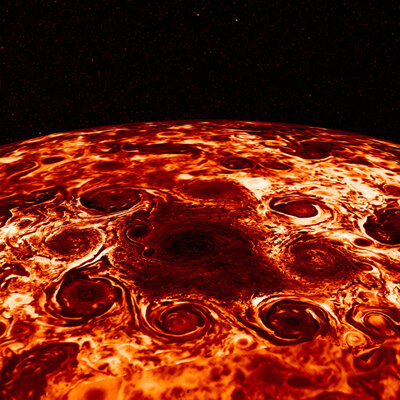
An article published in the journal “Proceedings of the National Academy of Sciences” reports a study on storms at the planet Jupiter’s south pole and their regular geometric pattern. A team of researchers from the University of Berkeley and Caltech used mathematical models derived from 19th-century research by Lord Kelvin based on experiments by physicist Alfred Mayer to explain why those storms concentrated in that area and why on Jupiter they’re arranged in that geometric formation.
Among the discoveries made by NASA’s Juno space probe during its observations from Jupiter’s orbit, there’s the cyclone system at the gas giant’s south pole. Andy Ingersoll, formerly part of the Juno mission team and one of the authors of this research, explained that the storms on Jupiter are in many ways similar to those that hit the east coast of the USA every summer and fall but on a much larger scale. On Jupiter, those storms also tend to form closer to the equator and then move towards the poles. The difference is that on Earth hurricanes and typhoons dissipate before moving too far from the equator but on Jupiter, they keep on moving until they reach the poles.
The key difference between storms on Earth and Jupiter is in the friction that is generated when they run into the Earth’s continents, which is far lesser on a gas giant with no solid surface. Jupiter also has much higher residual internal heat from its formation, comparable to what it receives from the Sun, so the temperature difference between its equator and its poles is not as great as on Earth. However, the presence of a group of storms at Jupiter’s south pole is a unique situation because, for example, Saturn has a single storm at each of its poles.
To understand why Jupiter has a group of storms arranged in a geometric pattern at the south pole, the researchers looked at old research conducted in 1878 by American physicist Alfred Mayer that allowed Lord Kelvin to develop a mathematical model to explain the results. Mayer placed floating circular magnets on a water surface and observed that they spontaneously arranged themselves in geometric configurations similar to those seen on Jupiter, with shapes that depended on the number of magnets.
That kind of study was never applied to a planetary surface before. To do this, the researchers used a set of equations known as shallow-water equations to build a computer model that could reproduce the processes taking place on Jupiter.
Cheng Li, lead author of this research, explained that he and his colleagues wanted to explore the combination of parameters that makes cyclones stable at Jupiter’s south pole. He and his colleagues found that a set of stable storms such as Jupiter’s would form when they are each surrounded by a ring of winds that rotate in the opposite direction from the storms, what’s called an anticyclonic ring. The presence of anticyclonic rings causes storms to repel each other instead of merging.
This study offers a solution to the mystery of the group of storms at Jupiter’s south pole, but Andy Ingersoll explained that it could help better understand weather behavior on Earth. That’s because other planets provide a much wider range of behaviors than what we see on Earth, so studying the weather on other planets allows to test theories that are applied to Earth’s weather. It’s not the first such case and it will not be the last.
