
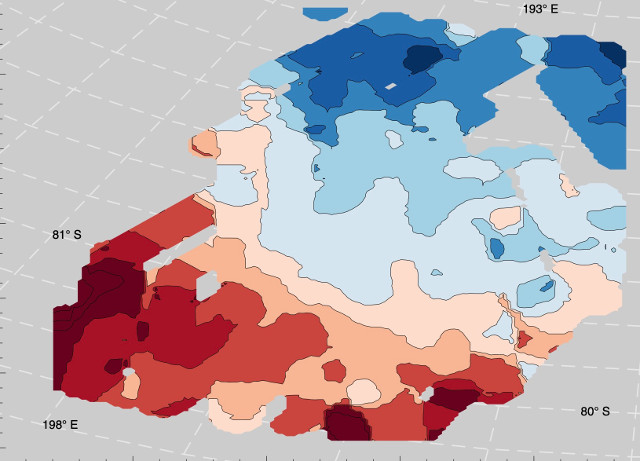
An article published in the journal “Nature Astronomy” reports the discovery of new underground lakes of very salty liquid water under the planet Mars’ south pole cap. A team of researchers led by Elena Pettinelli and Sebastian Lauro, both of the Italian Roma Tre University, used data collected by ESA’s Mars Express space probe’s Mars Advanced Radar for Subsurface and Ionosphere Sounding (MARSIS) instrument to discover what form a lake system consisting of three main lakes surrounded by other smaller lakes. This confirms the discovery of a lake announced in July 2018 and offers evidence that this is not a unique case. It remains an extreme environment, so it takes some speculation to imagine life forms in those lakes, but the authors of this new research also recommend increasing the exploration of those areas to understand their potential is to host life.
The discovery of traces of an underground lake of liquid water in the MARSIS radar signals opened the door to new research based on radar data collected by the Mars Express space probe with interesting implications for that environment. The temperatures are very low, so water can remain liquid only thanks to a strong concentration of salts which act as antifreeze. It doesn’t seem like an environment suitable for life forms, but if microbes had evolved when Mars was much more like Earth, perhaps they would have had time to adapt to progressively extreme conditions.
Regardless of hypothesis and speculation, studies of the area continued including some of the researchers who discovered the first lake and other fellow researchers. For example, Elena Pettinelli was among the leaders of the team that made the first discovery and subsequently led the team that confirmed its existence and discovered more lakes together with her colleague Sebastian Lauro. A methodology used on Earth to detect the presence of subglacial lakes in areas such as Antarctica, Canada, and Greenland was applied to the analysis of data detected by the MARSIS radar over time.
The increased amount of data and the new analysis methodology led to the discovery of three new main lakes. The largest of those lakes measures around 20 x 30 kilometers and is surrounded by several smaller ponds. Roberto Orosei, principal investigator of the MARSIS instrument and one of the authors of this research, explained that the existence of a single lake could be attributed to exceptional conditions, but the discovery of an entire lake system implies that their formation process is relatively simple and common and that these lakes have probably existed for much of Mars’ history. He added that for this reason, those lakes could still retain traces of any life forms born when Mars was young and similar to the Earth.
The MARSIS radar is an Italian instrument and the Italian Space Agency is developing a similar radar for ESA’s JUICE mission, which will aim to explore three of Jupiter’s moons: Ganymede, Callisto, and Europa. They have liquid water below their surface as well, so radar readings will be important. A mapping of the presence of liquid water in the solar system is an important step in the search for extraterrestrial life. There’s still a lot to do before we can say whether life forms might exist in Mars’ underground lakes, but certainly these are very interesting areas from an astrobiological point of view.
