
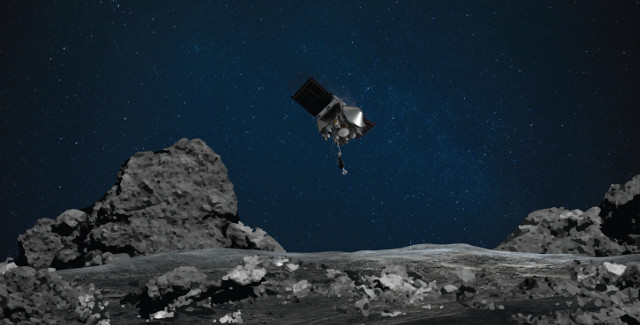
A few hours ago NASA’s OSIRIS-REx space probe descended to the surface of the asteroid Bennu to take soil samples in what was called TAG (Touch-And-Go). The selected area is in a crater that was named Nightingale with a diameter of about 16 meters in Bennu’s northern hemisphere. The operation was carried out fully automatically because there’s an 18.5 minute delay in communications due to the fact that OSIRIS-REx is about 334 million kilometers from Earth. If the result is satisfactory, this part of the mission will be over.
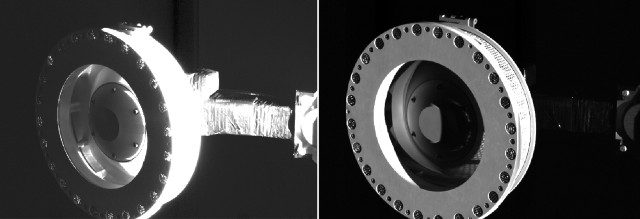
The TAG event lasted about 4.5 hours during which the OSIRIS-REx space probe performed a complex series of maneuvers to get our of asteroid Bennu’s orbit and, from an altitude of about 770 meters, begin the slow descent to its surface. It stayed there for less than 16 seconds during which it fired one of its pressurized nitrogen canisters which raised the materials on the surface. Part of them got scooped up in a device designed to collect dust and small pebbles, a robotic arm called the Touch-And-Go Sample Acquisition Mechanism (TAGSAM), shown in the bottom image (NASA/Goddard/University of Arizona), which is normally folded and was unfolded during the previous maneuvers.
Once the operation was completed, OSIRIS-REx went back to a safe distance, where it communicated the outcome of the operation to the mission control center. The instruments were designed so that it’s possible to perform a visual inspection of the samples and to evaluate TAGSAM’s mass variation. The mission scientists are expected to spend about a week making an initial evaluation of the samples to determine in particular if their amount is sufficient. The goal was to collect at least 60 grams of regolith, the materials on the surface of asteroid Bennu.
If at NASA they’re not satisfied with the results, it will be possible to set up a second TAG event as the OSIRIS-REx spacecraft has two more pressurized nitrogen canisters precisely to have the opportunity to attempt another sample collection. If the samples are found to be sufficient, they will be sealed in the Sample Return Capsule (SRC) to be returned to Earth for a real analysis in September 2023.
The OSIRIS-REx space probe reached asteroid Bennu on December 3, 2018, and it took longer than expected to complete this sample collection. That’s because the mission scientists discovered that Bennu has a surface covered with rocks which made the operation much more difficult. In 2020, the pandemic added further difficulties making it problematic for team members to work together. In the end, the collection went well, but at NASA they really hope that the amount of materials collected is enough to avoid another risky operation.

Permalink
Permalink