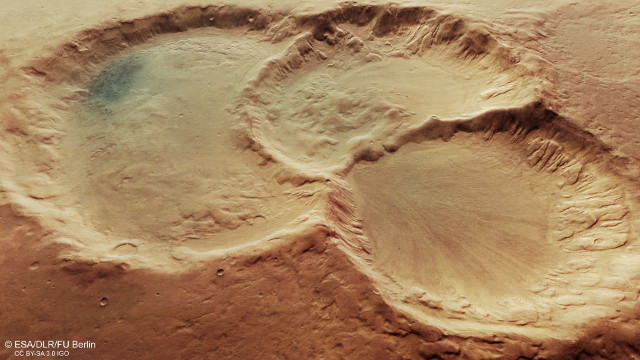

ESA has published photos taken by its Mars Express space probe’s High Resolution Stereo Camera (HRSC) of a crater triplet in the Noachis Terra region on planet Mars. That region gave its name to the Noachian era in which, between about 3.7 and 4.1 billion years ago, the red planet was hit by a particularly large number of meteorites, and Noachis Terra is full of craters still existing. A crater triplet with an overlap indicating three very close impacts is interesting not only as a curiosity but also for the geological history it can tell together with others from the same region.
According to scientists reconstructions, during the Noachian era, Mars was much more similar to the Earth, and traces that mainly concern the presence of liquid water can still be found today. For example, in the Noachis Terra region, there’s Greeley Crater with its signs of a complex geological history. The crater triplet is likely the result of a meteorite that broke up into three parts as it plunged into the atmosphere of Mars at a time when it was much denser than it is today. However, it can’t be ruled out that it’s a coincidence and three different meteorites hit almost the same area but, even if the impacts were common at the time, the odds are low.
The three overlapping craters, which have diameters of approximately 45, 34, and 28 kilometers, have edges made smooth by erosion, a typical feature of many impact craters in the highlands of the southern hemisphere of Mars. The interior of the craters is rather flattened, some ridges seem to have “melted” and sunk into the center of the crater depression, and numerous large gullies cut the slopes. Certain structures typically form when a mixture of debris and ice from a glacier in a crater moves down towards the center of the crater.
The environment around the crater triplet is very smooth, and only some of the neighboring craters appear to have well-defined shapes and edges, indicating that they’re relatively young and have not yet begun to be eroded. What looks like a melting in the oldest craters is a phenomenon typically generated by ice. According to the reconstructions, the ice beneath the surface of Mars, melting and flowing, made the soil become soft, contributing significantly to filling depressions and flattening the ground. It takes a significant amount of water to make that environment around the craters so smooth, a confirmation that in the Noachian era there were abundant water flows.
The study of this crater triplet, conducted thanks to photos taken on August 6, 2020, by the Mars Express space probe, contributes to the reconstruction of the history of Noachis Terra in particular and of the planet Mars in general. The dense atmosphere that Mars had at the time was slowly blown away by solar wind after the planet lost the magnetic field that acted as a shield, so the same thing can’t happen to Earth, but studying climate change on Mars helps to improve certain models also useful to study the Earth’s environment.