
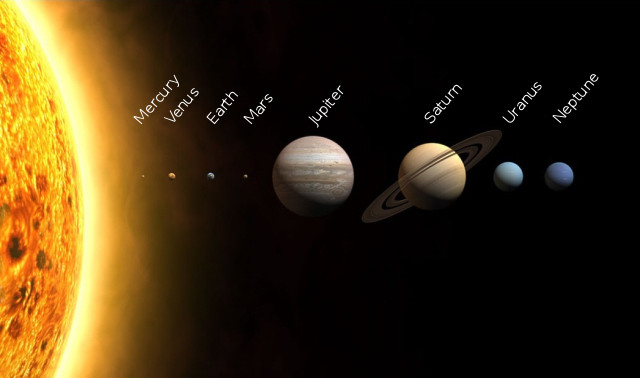
An article published in the journal “Icarus” reports a study on the solar system’s structure that offers a reconstruction of its origins. A team of researchers led by Matt Clement of the Carnegie Institution conducted over 6,000 simulations of the solar system’s evolution that led to the conclusion that Jupiter used to make three revolutions around the Sun in the time it took Saturn to make two revolutions when the two planets had just formed. The results also indicate that there was another planet between Saturn and Uranus that was ejected from the solar system, a conclusion that supports a hypothesis that has been studied for years.
The knowledge of planetary systems that astronomers continue to accumulate thanks to the discovery of new exoplanets are confirming that the solar system is out of the ordinary for the number of planets and their arrangement. Planets form together from a protoplanetary disk around their star, so at first, they tend to be close to each other and in circular orbits. Over time, gravitational interactions between the larger planets lead to orbital changes. Planetary migrations are a research topic that is expanding a lot thanks to the discovery of exoplanets and in particular of those like the hot Jupiters, very close to their stars, too close to have formed in that area.
A normal situation between planets is orbital resonance and according to various theoretical models, Jupiter and Saturn were originally in a resonance where three Jupiter years were equal to two Saturn years. The simulations conducted by Matt Clement’s team indicate that that situation has the greatest consistency with the results of the simulations that lead to a situation of the planets of the solar system like the current one.
The results also confirm another hypothesis, the one about the presence of another ice giant planet between Saturn and Uranus. Various models of planetary migration predict the existence of that planet and the fact that it was the victim of gravitational interactions with its neighbors ending up being pushed out of the solar system.
The position of Uranus and Neptune was influenced by the planet that got lost in space, which was probably similar to them. Another influence on them came from the existing mass in the Kuiper belt, where there are dwarf planets, asteroids, and comets. They’re all relatively small objects, but their overall amount could be enormous and therefore their mass has an influence on the neighbors. Not accidentally, some researchers believe that a group of objects in that area exert the influence attributed to the alleged ninth planet or planet X.
This study is based on simulations, which can provide inaccurate results even when they end with a planetary configuration very similar to the current one. However, the new confirmations of certain theories regarding the solar system’s evolution are significant. This is also important to reconstruct the formation of rocky planets to better understand the birth and evolution of the Earth and to search for exoplanets similar to it.

Permalink
There is another factor associated with planetary motion yet discovered. The Kepler Effect. Elliptical orbits are not stable they exert a force equal to the work being done on the orbiting body by accelerating the orbited body. Eventually an elliptical orbit will be pulled into the plan of the other orbiting bodies and finally get to a circular orbit and a stable system. Pluto if it doesn’t collide with Saturn will eventually regress to a circular orbit in the plane of the other planets. This is the primary mechanism that gives motion to atoms.
Permalink
Thank you for your contribution!