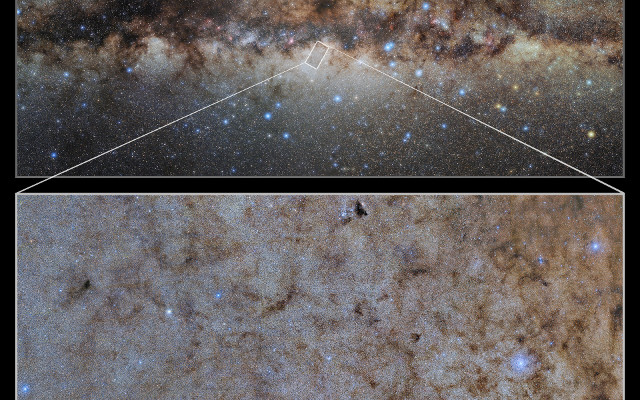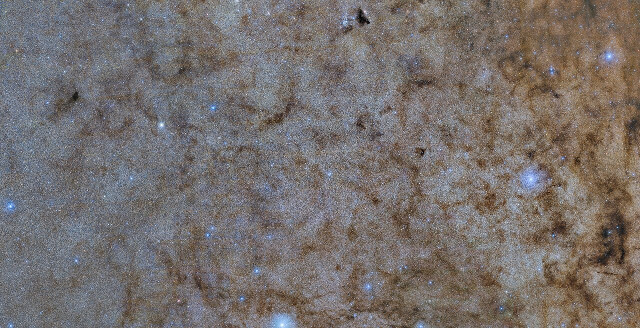
Two articles – available here and here – published in the journal “Monthly Notices of the Royal Astronomical Society” report different aspects of a research on what is commonly called the bulge, a large group of stars in the central area of the Milky Way. A team of researchers used the Dark Energy Camera (DECam) to conduct observations of the bulge, with its 250 million stars among which in particular the ultraviolet emissions of the ones in the cluster known as red clump were detected because it’s formed by red giants. By analyzing their emissions it was possible to find the spectroscopic traces of the chemical elements inside more than 70,000 stars. The red giants near the center of the Milky Way showed a very similar composition indicating that they formed around the same time, over 10 billion years ago.
The research connected to the study of the formation and evolution of the Milky Way includes the more than 250 million stars that form the bulge in the central area of the galaxy. A more in-depth study was possible thanks to the DECam, a camera mounted on the Victor M. Blanco telescope of the Cerro Tololo Inter-American Observatory, used in the Blanco DECam bulge survey (BDBS). The purpose of using the DECam was to map the Milky Way’s bulge and made it possible to detect the ultraviolet emissions of old stars that are part of what is called red clump. Over 7,000 bulge images were captured using DECam for a total of over 3.5 trillion pixels.
The wealth of data collected made it possible to conduct spectroscopic analyzes of the emissions of more than 70,000 stars in the red clump, a much higher number than in previous research, which had examined a much smaller number of stars. That analysis allowed to examine the stars’ chemical composition, which turned out to be very similar. That composition is the result of the combination of the composition at birth and the elements generated by the fusion of hydrogen and, after the start of their life’s last phase, of heavier elements. The very similar composition found in those stars indicates that they were born practically together, over 10 billion years ago.
The original purpose of the DECam was to map distant galaxies, supernovae, and cosmic structures that could help reveal the nature of dark energy. However, it also proved useful for research on relatively close objects. Understanding the formation and evolution of the Milky Way will help refine the general models for galaxies and understand the origin of the solar system and therefore of the Earth as well.