
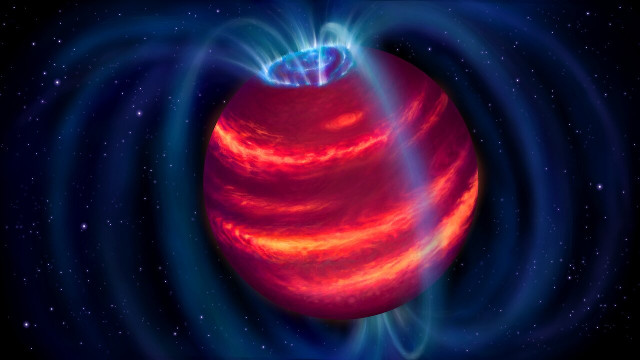
An article published in “The Astrophysical Journal Letters” reports the confirmation of the first detection of a brown dwarf through radio observations. This is the result of a collaboration between various entities that led to the use of the LOw Frequency ARray (LOFAR) radio telescope, the Gemini North telescope, and NASA’s InfraRed Telescope Facility (IRTF), both in Hawaii, to discover and characterize the brown dwarf cataloged as BDR J1750+3809. Being able to locate very faint objects with a radio telescope represents a significant advance because it will help to learn more about brown dwarfs and offers the hope of even finding exoplanets ejected from their star systems.
So far, brown dwarfs, objects between star and planet, have been discovered during surveys based on observations at optical or infrared frequencies. However, just like in gas giant planets, their magnetic fields accelerate charged particles such as electrons, which generate electromagnetic radiation in the range of radio waves and in the form of auroras. The problem is that Jupiter is close in astronomical terms while even the closest brown dwarfs are a few light-years away, with the consequence that their radio emissions that reach the Earth are very weak.
In the past, radio emissions from some known brown dwarfs were detected, so this is possible. A team of researchers tried to use the LOFAR radio telescope to find traces of radio emissions from a possible brown dwarf. These types of objects, like stars and planets but not galaxies, emit a form of circularly polarized light. The researchers found a radio source with those characteristics and at that point tried to look for other electromagnetic emissions coming from it using the Gemini North and IRTF telescopes. In particular, the Gemini Near-Infrared Spectrograph (GNIRS) instrument mounted on the Gemini North telescope provided high-quality images that contributed to the confirmation of the existence of the brown dwarf that was cataloged as BDR J1750+3809.
This is a major success as research on brown dwarfs is still under development. The first object of this type was identified only in 1995, and sophisticated new-generation instruments made it possible to discover more of them, but there’s still work to be done. This means that discovering a brown dwarf with a radio telescope is a step forward but required a lot of work. The hope is that this will also be useful for discovering exoplanets ejected from their star systems. By exploiting the similarities between brown dwarfs and gas giant planets, the researchers also hope to test models of their magnetic fields, helping to understand the evolution of brown dwarfs and gas giants.
