
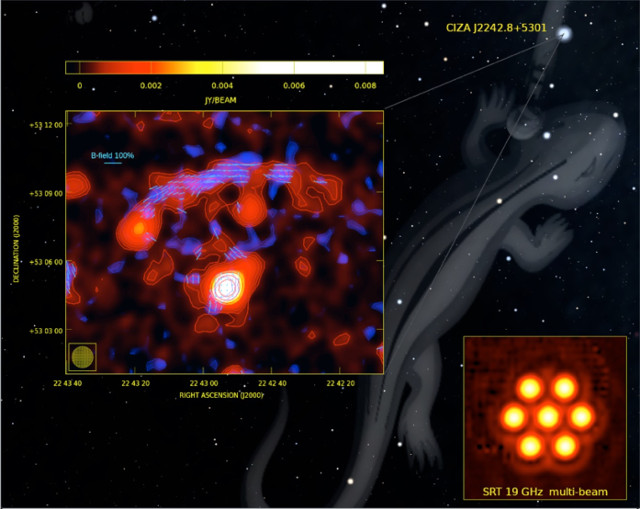
An article published in the journal “Monthly Notices of the Royal Astronomical Society” reports a study on the galaxy cluster CIZA J2242.8+5301. A team of researchers led by astrophysicist Francesca Loi of the Italian National Institute of Astrophysics, Cagliari, used the Sardinia Radio Telescope (SRT) to conduct 240 hours of observations to obtain the highest-frequency spectro-polarimetric image ever produced by a radio telescope of what in jargon is called a radio relic. The quality of the observations enabled to obtain better results than previous studies, which were contradictory, leading to controversy.
Some galaxy clusters host diffuse and elongated radio sources, called radio relics in jargon, not to be confused with radio halos, which are at the center of the clusters instead. Radio relics are typically associated with shock waves that propagate in the intra-cluster medium as a result of galaxy mergers. However, the mechanisms leading to these phenomena are still poorly understood.
The galaxy cluster CIZA J2242.8+5301, about 3 billion light-years from Earth, hosts a radio relic discovered in 2007. In the following years, this phenomenon has been studied several times also leading to a controversy because in 2016 a quick drop in the radio signal from a source in this cluster was detected. That decline was surprising and was attributed to the inherent characteristics of the radio relic. Subsequent studies offered other explanations but required significant changes to existing models. This new research conducted with SRT offers a better explanation thanks to the high quality of the new observations.
SRT made it possible to obtain detections of the galaxy cluster CIZA J2242.8+5301 at 18.6 GHz, a very high radio frequency for an object hosting a radio relic. The result is that what in 2016 was interpreted as a quick drop in a radio signal was due to the instrumental limits of the group of radio telescopes used together through the radio interferometry technique. SRT’s detections indicate that the decline is not quick at all but very linear and progressive.
The image (courtesy INAF for the radio images, Stellarium for the background, elaboration Matteo Murgia, INAF-OAC 2020. All rights reserved) shows the radio relic in the galaxy cluster CIZA J2242.8+5301 observed at 19 GHz. The vectors in light blue indicate the intensity of the magnetic field’s lines of force. At the bottom right, a representation of the seven beams that SRT can pick up simultaneously at that frequency.
Francesca Loi explained that this study proves how much SRT can contribute not only to help understand the origin and evolution of radio relics in galaxy clusters but also to broaden our radio window on the universe. The reference is to radio astronomy at medium and low frequencies, carried out with various radio telescopes. SRT can help with high-frequency precision spectro-polarimetric observations.
The combination of different instruments can be crucial in certain astronomical studies. This study shows that an observation conducted with the most suitable instrument can make all the difference in the study of a cosmic object. In this case, it proves that SRT can be the perfect instrument for certain studies.
