
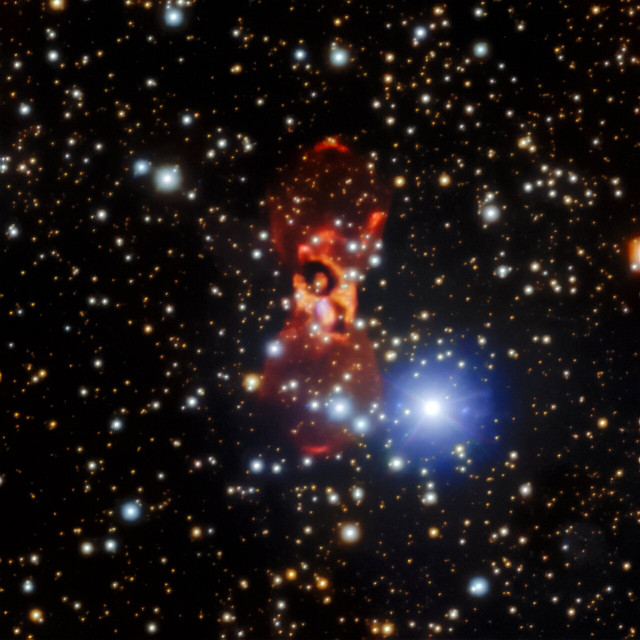
An article to be published in the “Astrophysical Journal Letters” reports a research on CK Vulpeculae (CK Vul), what was considered a well documented nova having been described between 1670 and 1672, also for the bipolar nebula that left and was recently studied. A team of astronomers led by Dipankar Banerjee, Tom Geballe, and Nye Evans used the GNIRS spectrograph mounted on the Gemini North telescope to obtain measurements that led to the conclusion that CK Vulpeculae is about 10,000 light-years away from Earth, five times as far as previously estimated, and that the explosion was more powerful than a nova but not at the levels of a supernova.
CK Vulpeculae was visible for almost two years even with the naked eye during the brightness peaks that led to it being cataloged as a nova. Recently, the bipolar nebula that remains has been the subject of studies to try to understand its exact nature, but there are still conflicting theories. According to a study reported in an article published in the journal “Monthly Notices of the Royal Astronomical Society” in October 2018, the event was caused by the collision between a white dwarf and a brown dwarf. Today, a new study adds new questions about an event that is even more anomalous than astronomers thought.
The new conclusions, with some new answers but also some new questions, about CK Vulpeculae came after the researchers observed it with the GNIRS (Gemini Near-Infrared Spectrograph) instrument mounted on the Gemini North telescope in Hawaii. The original idea was to examine what remains in the heart of the nebula, but the astronomers realized that this would be far more difficult than expected. At that point, they conducted observations of the entire nebula, up to the edges of the two lobes. This allowed them to detect the redshift and blueshift the iron atoms inside it, which in turn allowed them to estimate the lobes’ expansion rate, which was much higher than suggested by previous observations, up to 7 million km/hour.
Putting together the new data of CK Vulpeculae’s expansion rate with others already known, such as the expansion measured over the past decade, the researchers estimated that it’s about 10,000 light-years away from Earth, about five times more than the previous estimates. This means that the explosion sighted in 1670 was much brighter, and therefore much more powerful, than was estimated, with about 25 times more energy released than previous estimates. Basically, if it was considered an anomalous nova before, this new study puts it in a different category.
In the past, some events with a brightness between the nova and the supernova were detected, leading to the creation of the class of Intermediate Luminosity Optical Transients (ILOT) objects. In some cases, these events have been explained as the result of a merger between stars, but CK Vulpeculae has very peculiar characteristics.
Dipankar Banerjee stated that it’s currently difficult to give a definitive and compelling explanation for the origin of CK Vulpeculae. He and his colleagues remain open to any theory. This study can help to discover other events of that type, between the nova and the supernova, hoping to obtain more information on the mechanisms that generate them.
