
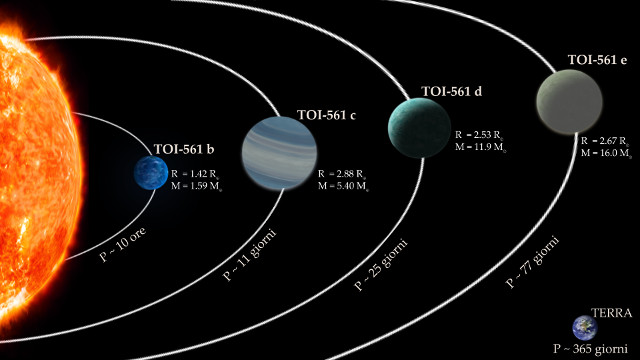
An article published in the journal “Monthly Notices of the Royal Astronomical Society” reports a study on the planetary system of the star TOI-561, which includes a super-Earth and three mini-Neptune (Image courtesy Italian National Institute for Astrophysics. All rights reserved). A team of researchers used data from NASA’s TESS space telescope and follow-up research with the HARPS-N spectrograph mounted on the Galileo National Telescope (TNG) on the Canary Island of La Palma to distinguish the traces of the planets and to measure some of their characteristics.
A surprising result is the mass of the innermost planet, lower than expected, indicating a low density that the researchers explained with a considerable presence of water, which is probably frozen under high pressure even if the temperatures on the surface are high enough to melt rocks.
Launched on April 18, 2018, the TESS Space Telescope is providing excellent results with the discovery of new exoplanets and sometimes entire planetary systems. However, even for such a sophisticated instrument, sometimes it’s difficult to offer reliable data, especially when there are multiple exoplanets close to their star with many transits in front of it. In the case of the famous TRAPPIST-1 system, long studies were needed to identify its seven planets.
In the case of the TOI-561 system, a star whose mass and size are just over 80% of the Sun, the planets eventually identified are “only” 4, but follow-up observations were still required using the HARPS-N (High Accuracy Radial velocity Planet Searcher for the Northern emisphere) spectrograph on the TNG to realize that there were more planets than the 3 suggested by the data collected by TESS.
Gaia Lacedelli, PhD student at the Italian the University of Padua’s Department of Physics and Astronomy and first author of the article, explained that the TOI-561 system immediately attracted her and her colleagues’ attention, but something did not add aup in the follow-up observations conducted with HARPS-N. In essence, TESS exploits the transits of exoplanets in front of their stars to discover them while HARPS-N exploits the technique of radial velocity, but the data of the two instruments didn’t match.
The exoplanet TOI-561 b turned out to be truly curious. It’s very close to its star, with a year lasting about 10 Earth hours. This means that the temperature on its surface is estimated to be around 2260° Celsius. However, the density calculated from the data collected thanks to the various observations is low, suggesting the presence of a significant amount of water. Given the temperature on the planet, it could be high pressure ice present deep down underground, perhaps even in its core.
The researchers intend to conduct more observations with HARPS-N but also with ESA’s CHEOPS space telescope, a perfect instrument to obtaining more precise information on the characteristics of all the planets of the TOI-561 system. It will be interesting to learn more about this planetary system with this curious super-Earth that is hot and full of ice at the same time.
