An article published in the “Planetary Science Journal” reports a study on the seven planets of the ultra-cool dwarf star TRAPPIST-1’s system. A team of researchers led by astrophysicist Eric Agol of the University of Washington used data collected by the Spitzer Space Telescope over four years, by the Hubble and Kepler space telescopes, and by ground-based telescopes to obtain precise measurements of the planets’ masses and densities. The new calculations indicate that the seven planets have a very similar density, a new clue in the study of their composition with the possible similarities and differences compared to the rocky planets in the solar system.
After the confirmation of the presence of seven rocky planets in the TRAPPIST-1 system announced on February 22, 2017, a lot of research focused on them. The very small size of the star and the proximity of the planets to it make this system more similar to that of Jupiter and its moons than to the solar system. Despite this, there’s the possibility that at least some of them are similar to Earth not only in mass and size but also in atmosphere and temperatures on their surface.
Over the years, various space and ground-based telescopes have been used to study the TRAPPIST-1 system accumulating increasing amounts of data. This allowed Eric Agol’s team to obtain more refined measurements of the characteristics of the seven planets. In particular, they calculated their mass and their size, which allowed them to calculate their density.
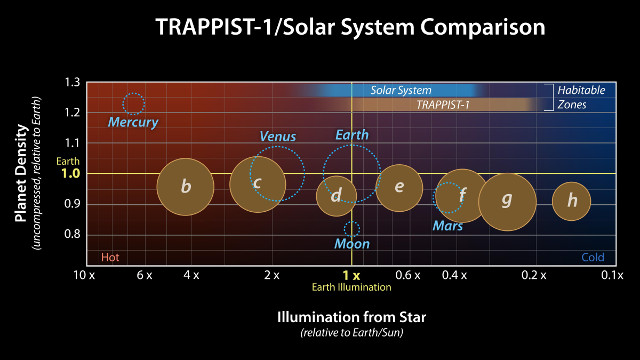
The result is that, subtracting the effects of gravity and its subsequent compression, the planets of the TRAPPIST-1 system have very similar densities, with differences within 3%. This suggests that they share a similar composition and also similar to Earth but not the same. They have a density that is about 8% lower than the Earth’s, and this suggests some possibilities in their composition. A comparison between the densities and illumination of the TRAPPIST-1 planets and the solar system’s rocky planets with respect to Earth is shown in the top image (NASA/JPL-Caltech).
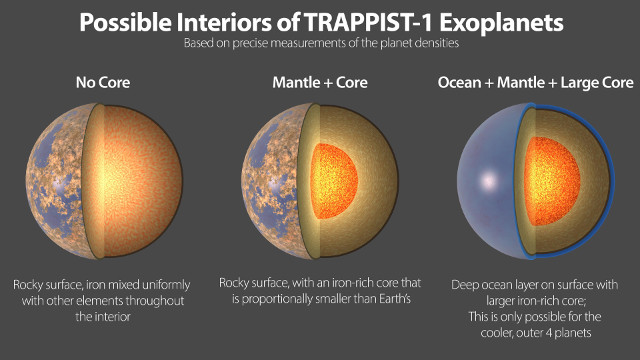
The characteristics of the planets of TRAPPIST-1 leave open some possibilities regarding their composition, illustrated in the bottom image (NASA/JPL-Caltech). The first possibility is that they don’t have an iron-rich core like the Earth but the various materials are mixed evenly throughout their interior. The second possibility is that they have a composition similar to Earth but with smaller iron-rich cores. The third possibility is that they have iron-rich cores like the Earth’s balanced by an abundance of water.
Previous research proposed the idea that there are some waterworlds, but in the inner ones the temperatures on the surface should be too high to maintain oceans of liquid water. There should be dense atmospheres to hold water, even as steam, but it seems unlikely that there’s enough left to have very similar densities between the inner and outer planets.
The presence of iron-rich cores also offers some variations. For example, iron could be oxidized, and oxygen could decrease the density of the core. Combinations are also possible between cores with less iron and a certain oxidation that decreases their density.
Advances in research on the TRAPPIST-1 system also show improvements in models about exoplanets. The continuing discovery of new exoplanets and their study offers new data. Samples becoming broader and broader lead to increasing accuracy in the estimates of their characteristics improving the models. The TRAPPIST-1 system, with seven rocky planets, remains an extraordinary space laboratory for planetary astronomy, so studies about it will continue.