
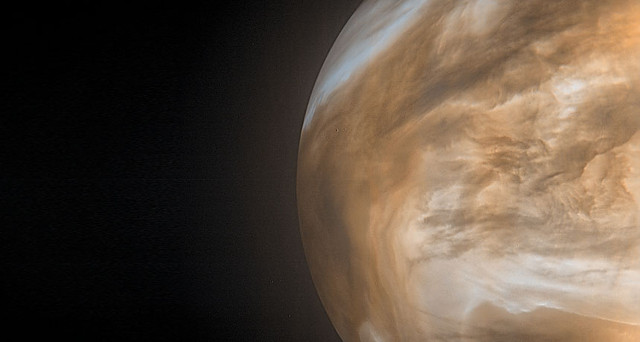
An article accepted for publication in “The Astrophysical Journal” reports research that offers an alternative explanation to the presence of phosphine on Venus. A team of researchers used a robust model of the conditions in Venus’s atmosphere reanalyzing the data that led to the conclusion that there was phosphine. The new conclusion is that the data are consistent with the presence of sulfur dioxide.
The statement about the presence of phosphine in the atmosphere of Venus was sensational because as far as we know only anaerobic bacteria can produce it in that quantity. Of course, reproducing the extreme conditions of Venus in lab to perform experiments is really difficult, so there was caution in interpreting those conclusions. Subsequently, other researchers expressed doubts about that interpretation of the collected data and now a study offers an alternative explanation that seems more plausible.
What was interpreted as the presence of phosphine in the very hot atmosphere composed of 96% carbon dioxide was an observation conducted with the James Clerk Maxwell Telescope (JCMT). Subsequently, it appeared to have been confirmed by observations conducted with the ALMA radio telescope. Now it appears that the problem was in the interpretation of the data.
For this new study, the researchers used a radiative transfer model using data from Venus’ atmosphere collected over decades by space probes and telescopes from Earth. This approach led to the conclusion that what was interpreted as phosphine’s chemical signature didn’t come from the clouds of Venus but from an area some 80 kilometers or more above the planet’s surface. It’s an altitude where harsh chemicals and ultraviolet radiation would destroy phosphine molecules within seconds.
The researchers also found that the data detected by the ALMA radio telescope likely significantly underestimated the amount of sulfur dioxide in Venus’ atmosphere. That’s an important factor because it helped to attribute the signals obtained to phosphine.
This new analysis shows how the interpretation of electromagnetic signals can be difficult. The various compounds are not seen directly but are recognized thanks to the traces they leave in the emissions coming from an object, in this case Venus. These are traces that may require an interpretation that also depends on the characteristics of the instruments used for the observations. Incomplete data and instrumental limitations can lead to misinterpretations and this appears to be the case. Astronomy is a science therefore the control of data and the results of their analysis is crucial. Research on Venus will continue even though there’s probably no phosphine because there’s still a lot to understand about that planet.
