 An article published in the journal “Astronomy & Astrophysics” reports the discovery of the largest supernova remnant in X-rays. A team of researchers used observations conducted with the Spektr-RG space telescope’s eROSITA instrument to create its first X-ray map of the sky to locate the traces of the supernova remnants that have been nicknamed Hoinga. The discovery was confirmed in radio frequency data from the CHIPASS survey conducted with the Parkes radio telescope.
Stars that are far more massive than the Sun explode into supernovae which, according to astronomers’ estimates, should occur in the Milky Way once every 30-50 years. A supernova is visible for a few months but its remnants can be detected for an estimated time of around 100,000 years before they disperse and it becomes possible to detect only what remains of the star’s collapsed core, which may be a neutron star or a black hole. About 1,200 supernova remnants should be detectable in the Milky Way, but we know about 300 of them, so either the estimates are wrong or there are problems in detecting supernova remnants.
A team of astronomers tried to search for supernova remnants among the X-ray sources detected by the eROSITA instrument while conducting the observations that led to the X-ray sky map, and the results suggest that the problems are in the instruments used to search for supernova remnants.
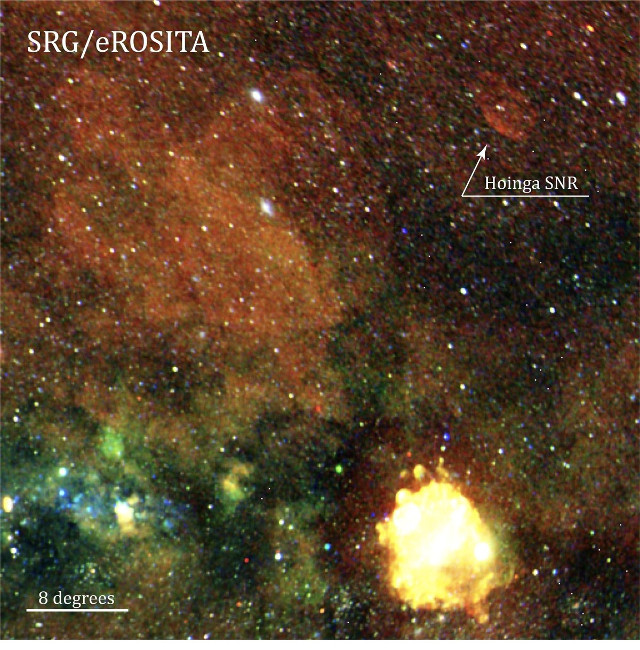
The eROSITA instrument is about 25 times more sensitive than its predecessor ROSAT and made it possible to detect an X-ray source compatible with a supernova remnant. The area of that source is very large, about 4.4 degrees or 90 times the area occupied by the Moon in the sky making it the largest supernova remnant discovered in X-rays. Werner Becker of the Max Planck Institute for Extraterrestrial Physics, the article’s first author, explained that he and his colleagues were surprised that this supernova remnant appeared right away. The rest was nicknamed Hoinga after the medieval name of his hometown, Bad Hönningen on the Rhine.
Another surprise came from the fact that Hoinga is far from the galactic plane. Most of the supernova remnants have been discovered in the area of the galactic disk because there’s a greater star-forming activity that favors the birth of massive stars and the consequent supernova explosion. Perhaps there are areas of the Milky Way that should be examined more carefully to find other supernova remnants.
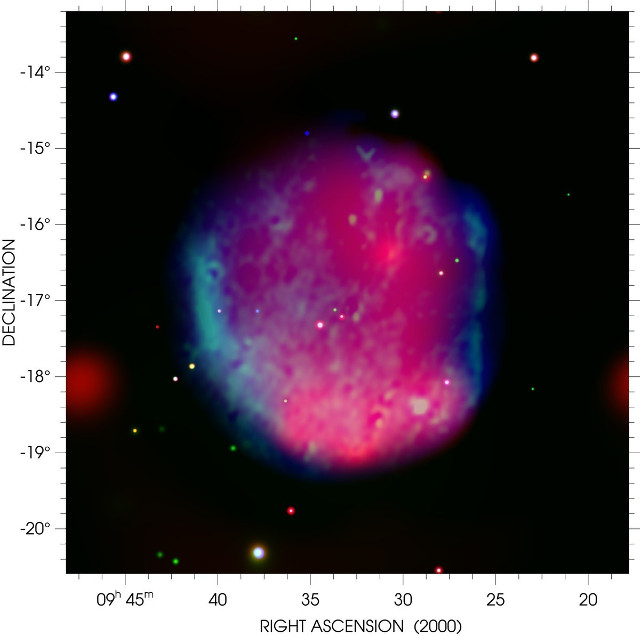
After the discovery of the X-ray source in the map created thanks to the observations of eROSITA, the researchers looked for confirmations. Hoinga also appears in the archive data of the observations conducted with ROSAT but the emissions are so dim and in an unusual position that no one had noticed them. In addition to X-rays, supernova remnants also emit radio waves, and the ones from Hoinga were found at frequencies typical of supernova remnants in the archive of the CHIPASS (Continuum HI Parkes All-Sky Survey) investigation conducted with the Parkes radio telescope.
The top image (Courtesy eROSITA/MPE (X-ray), CHIPASS / SPASS/N. Hurley-Walker, ICRAR-Curtin (Radio)) shows Hoinga in a composition of X-ray and radio wave emissions. The bottom image (Courtesy SRG/eROSITA) shows the portion of the sky in the Hoinga area seen by eROSITA.
Hoinga was discovered thanks to a very advanced instrument such as eROSITA, which has already proven its usefulness several times in various types of astronomical research. In this case, it showed that there are supernova remnants that are difficult to detect, and this suggests that there may be many others that have dim emissions, are in unlikely areas, or are close to much brighter sources. Supernovae generate elements that are projected into interstellar space and can help form new generations of planets. This means that to understand the formation of planets, which composition is crucial for their evolution, they need to study supernovae as well.