
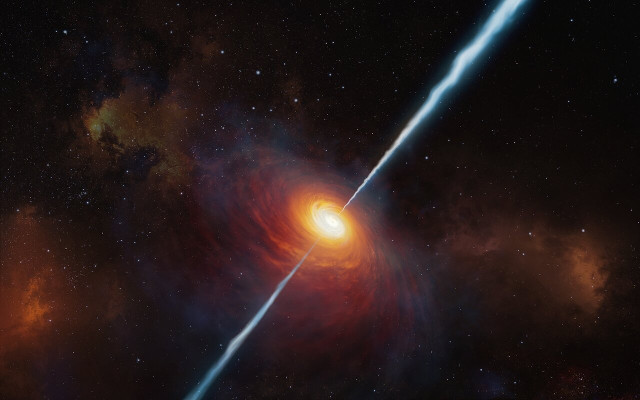
An article published in “The Astrophysical Journal” reports the discovery of the most distant radio-loud quasar. A team of researchers led by Chiara Mazzucchelli, a Fellow at ESO in Chile, and Eduardo Bañados of the Max Planck Institute for Astronomy used various telescopes to identify the quasar cataloged as PSO J172.3556+18.7734 and simply called P172+18. This quasar is about 13 billion years old and that means we see it as it was when the universe was very young, less than 800 million years after the Big Bang. It can offer new insights into the primordial universe and the objects its emissions passed through to reach Earth.
Quasars are powered by supermassive black holes that heat the materials around them to the point of generating powerful electromagnetic emissions in them. This makes them the brightest objects in the universe, and it’s for this reason that it’s possible to detect their emissions even at distances of billions of light-years. However, primordial quasars are so distant that even with the most modern instruments it’s difficult to identify them. The consequence is that only in recent years, with a lot of work, it’s possible to make the most of the possibilities of these instruments.
The term quasar means quasi-stellar radio source and was created before astronomers understood their nature. Despite the definition of radio sources, only 10% of known quasars generate powerful radio emissions, which in jargon are called radio-loud. Understanding the reasons for these differences in their emissions can help to better understand the processes taking place around the supermassive black holes that power them and their evolution.
In the case of the quasar P172+18, the supermassive black hole has a mass estimated to be nearly 300 million times the Sun’s. Some of them were identified with masses that are billions of times the Sun’s, but the one at the center of this study is growing very fast because there are huge amounts of gas and dust around it it’s devouring very quickly.
The differences in radio emissions between quasars such as P172+18 and the majority, the ones defined as radio-quiet, are being studied. One possibility is that there’s a link with the speed with which it swallows materials but which one? The most obvious interpretation is that considerable activity leads to the generation of powerful radio emissions, but the authors of this study suspect that the opposite may be true. Essentially, they suspect that the powerful radio jets may interact with the materials surrounding the supermassive black hole in a way that favors their fatal approach.
The discovery of the quasar P172+18 was confirmed thanks to various instruments such as the X-shooter spectrograph mounted on ESO’s VLT (Very Large Telescope) in Chile, the VLA (Very Large Array), and the Keck telescope in the USA. It’s the most distant radio-loud quasar discovered so far, but the researchers think there may be others even further away. Some radio-quiet quasars in the early universe are known, and the discovery of J0313-1806, or simply J0313-1806, a little farther away than P172+18, has recently been announced. They can offer new insights into the evolution of galaxies in the early universe and the processes that led to today’s universe.
