
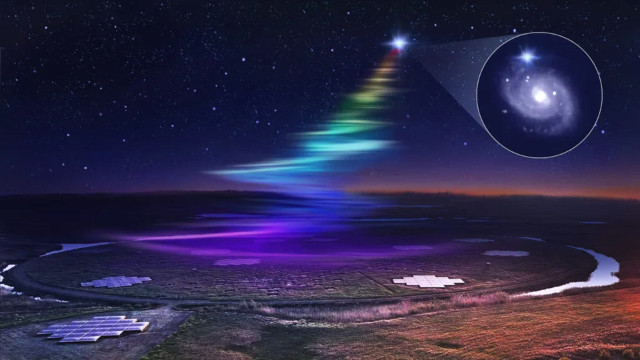
Two articles, one published in “The Astrophysical Journal Letters” and one published in “Nature Astronomy”, report various aspects of a research on the fast radio burst FRB 20180916B, whose emissions include the lowest frequencies at which such an event has been detected so far. Two teams of researchers with various members in common used detections obtained with the LOFAR radio telescope and the European VLBI network to study this fast radio burst that is repeating with a periodicity of just over 16 days. Its origin has been pinpointed in a small region around a neutron star.
The fast radio burst FRB 20180916B, full denomination FRB 180916.J0158+65, was first detected in 2018 by the CHIME (Canadian Hydrogen Intensity Mapping Experiment) radio telescope. These very powerful emissions can be a one-time event or repeating events, and in this case, it’s a repeating event, which helps its study. The European VLBI (Very Long Baseline Interferometry) network, which uses a number of radio telescopes as if they were a single gigantic instrument, contributed to its study.
A team of researchers led by astronomer Ziggy Pleunis of McGill University studied the fast radio burst FRB 20180916B using the LOFAR (LOw Frequency ARray) radio telescope to examine 18 repeats of this event. A surprise came from the fact that some events had emissions that went down to frequencies of 110 MHz while so far the fast radio bursts were detected up to 300 MHz. 110 MHz is the lowest limit of the detections made with LOFAR, so the emissions probably reach even lower frequencies as well.
Another interesting discovery related to the emissions of the fast radio burst FRB 20180916B is in their characteristics. The periodicity is just over 16 days with 4 days of bursts and 12 days of quiet. There’s a delay of about three days between the highest frequencies detected by CHIME and the lowest ones detected by LOFAR. This may depend on the characteristics of those emissions’ source.
A team of researchers led by Kenzie Nimmo of ASTRON and the University of Amsterdam used the detections obtained by the European VLBI network to try to get the event’s details. This made it possible to identify its source in a system about 500 million light-years from Earth. Probably, the origin system is composed of a neutron star that might orbit a massive star.
Recent studies indicated links between fast radio bursts and magnetars, a type of neutron star. In this case, the researchers suggest processes taking place in a neutron star’s magnetosphere. Each study offers new insights into these phenomena, and the fast radio burst FRB 20180916B can be important due to its repetitions to investigate it thoroughly.
