
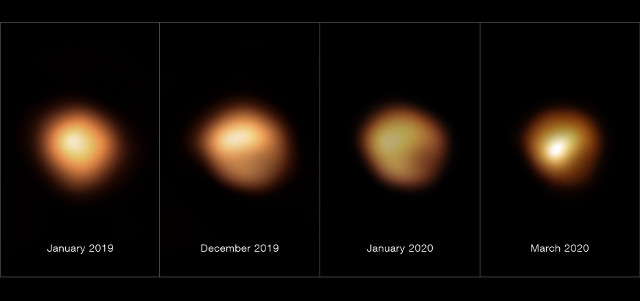
An article (link to the file in PDF format) published in the journal “Nature” reports a study on the dimming of the star Betelgeuse that happened between the end of 2019 and the first quarter of 2020 that suggested that its explosion in a supernova was imminent. A team of researchers led by Miguel Montargès of the Katholieke Universiteit Leuven in Belgium used ESO’s VLT to obtain images of Betelgeuse in December 2019 to compare with one from January 2019 and other subsequent images. The results confirm those of a previous study concluding that a gigantic mass of very hot plasma has risen from the surface of Betelgeuse. The plasma moved away, cooling and turning into dust that covered the star’s surface, reducing its brightness to a third of normal.
The red supergiant Betelgeuse is a star that is approaching the end of its life, which will happen with a supernova. That’s an unstable phase in which Betelgeuse’s brightness is variable but the dimming that began in October 2019 that had a minimum in February 2020 made the news. Perhaps the moment of the supernova had arrived but already at that time, some astronomers proposed other theories, including that of the cloud of dust generated by materials ejected from Betelgeuse.
Astronomer Miguel Montargès is among the ones who had been studying Betelgeuse for some time with the VLT (Very Large Telescope) and was also part of the team that studied this star with the Hubble Space Telescope as part of a three-year monitoring study of the variations of its atmosphere. The results of that study on Betelgeuse dimming were reported in an article published in “The Astrophysical Journal” in August 2020 that already concluded that the dimming was caused by dust.
The new study based on the observations conducted with the VLC was based in particular on two instruments: SPHERE (Spectro-Polarimetric High-contrast Exoplanet REsearch), which allowed to obtain direct images of the star’s surface, and GRAVITY, which exploits the possibilities of the interferometer combining data from multiple VLT telescopes to monitor the changes in the star as it dims. The image (ESO/M. Montargès et al.) shows photos of Betelgeuse captured using the SPHERE instrument at four different times when the star’s brightness was visibly different.
The researchers also considered other explanations besides the ejection of materials that have become dust. The analysis of the data collected led them to discard the possibility of a passing dust cloud and a real drop in temperature on Betelgeuse. The spectrometric data confirmed that the dimming was due to dust but indicating that it must have recently formed from the cooling of plasma ejected by the star itself.
The confirmation of the cause of Betelgeuse’s dimming can be disappointing because it’s not a clue to its impending explosion. However, it’s interesting from a scientific point of view because it shows an occasional ejection process that could help better understand what happens in red supergiant stars in the later stages of their life. The ejected materials end up in interstellar space and could end up in new star systems in formation. That’s another reason why the study of Betelgeuse will continue and the new instruments that will come into service in the coming years will help to study other stars of this type as well.
