Two articles, one published in “The Astrophysical Journal” and one in “The Astrophysical Journal Letters”, report various aspects of a study of the protoplanetary disk surrounding the young star Elias 2-27. Two teams of researchers with various members in common and Teresa Paneque Carreño as principal investigator used the ALMA radio telescope to study that star system in formation. In particular, they studied the gravitational perturbations that generated the spiral arms in the disk. This is a step forward in understanding the mechanisms of formation of new planets.
The discovery of a protoplanetary disk with spiral arms around the star Elias 2-27 was reported in an article published in September 2016 in the journal “Nature”. It was the first structure with that shape ever observed, a result obtained using the ALMA (Atacama Large Millimeter/submillimeter Array) radio telescope, inaugurated in March 2013. It was clear that the study of Elias 2-27’s system in formation was only at the beginning and that further studies were needed to understand the mechanisms behind that spiral shape. Astronomer Laura Perez, who led the team that conducted that study, and some other members of that team continued the work as part of the team that conducted the new studies now published.
A result of the study published in 2016 offered evidence of the shock inside the protoplanetary disk generated by density waves, gravitational perturbations that produced spiral arms similar to those of galaxies but on a much smaller scale. Those perturbations were linked to the mechanisms of planetary formation but further observations were needed to understand the processes in place.
The new observations conducted with ALMA made it possible to obtain confirmation of some theoretical predictions related to the perturbations existing in the protoplanetary disk. The disk mass is important to generate planets and one of the two articles just published is dedicated specifically to its estimation. The new study confirms that larger dust grains are present along the spiral arms while smaller ones are distributed throughout the protoplanetary disk. Asymmetric gas flows were detected throughout the study indicating that there may still be an inflow of materials into the disk.
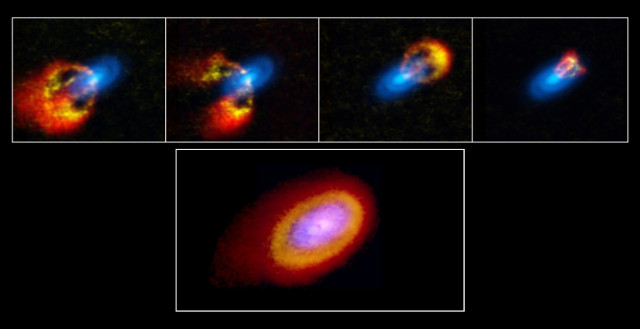
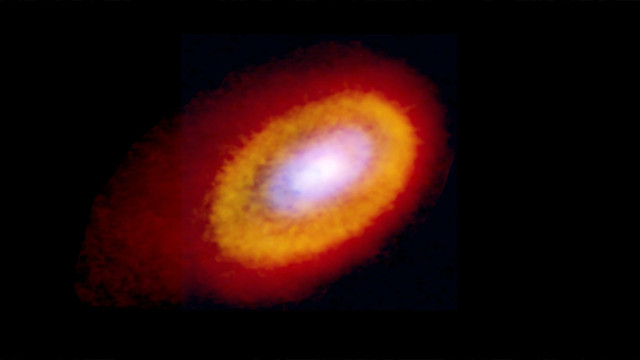
The carbon monoxide present in the protoplanetary disk around the star Elias 2-27 was studied by exploiting the presence of various isotopes of the two atoms. The top image (Teresa Paneque-Carreño/ Bill Saxton, NRAO/AUI/NSF) shows a composite image of the dust in blue, the carbon monoxide with carbon-13 in red, and the molecule with oxygen-18 in yellow. The bottom image (Teresa Paneque-Carreño/ Bill Saxton, NRAO/AUI/NSF) shows various composite views of that system in formation used to calculate the mass of the disk and to trace the perturbations within it.
The accumulated observations also made it possible to obtain information on the movements within the system of Elias 2-27 which offered a possibility to estimate the masses. The result is that the star has a mass that is about 46% of the Sun’s and the protoplanetary disk has an overall mass that is about 8% of the Sun’s.
The study of the Elias 2-27 system made progress but the processes that will lead to the formation of planets last millions of years. These systems in formation that are near the Earth from an astronomical point of view are excellent for this type of study but it takes a very long time to see even small changes.