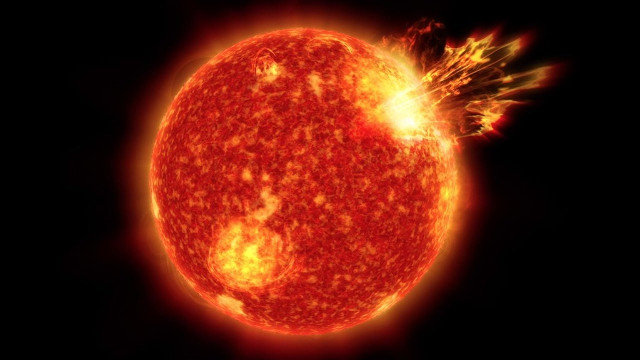
An article published in “The Astrophysical Journal” reports a study on the star Kappa 1 Ceti, very similar to the Sun in size and mass but much younger having an estimated age between 600 and 750 million years. A team of researchers coordinated by NASA’s Goddard Space Flight Center predicted some hard-to-measure features of Kappa 1 Ceti using computer models based on data collected by various NASA and ESA space telescopes. The results help to understand what the Sun looked like nearly four billion years ago, when it could emit superflares, to reconstruct the influence of its activity on early Earth and early life.
Young stars tend to be active and then “calm down” over time. Solar flares are being watched for because they’re potentially dangerous to orbiting satellites and, in extreme cases, to electrical equipment on Earth as well. However, what are technically called coronal mass ejections are little events compared to the superflares of four billion years ago, which could have been millions of times more intense.
That intense solar activity certainly influenced the evolution of the Earth and the formation of life on the planet but the reconstruction of those very remote events is incredibly difficult. For this reason, the study of young Sun-like stars is important and not just for astronomers. Kappa 1 Ceti is a perfect star for this type of study, also because it’s just under 30 light-years away from Earth, practically in the neighborhood from an astronomical point of view.
Computer models developed in the past to study solar activity have been adapted to predict the behaviors of other stars such as Kappa 1 Ceti. The data needed for this study was collected during various astronomical missions such as those of the Hubble Space Telescope, NASA’s TESS and NICER Space Telescopes, and ESA’s XMM-Newton Space Telescope.
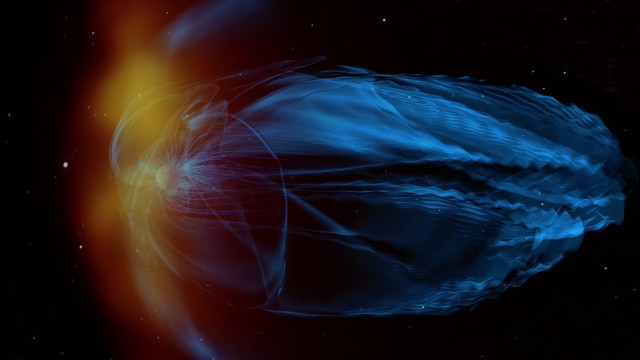
The data collected from the observations made it possible to conduct simulations that help to understand the superflares of stars such as Kappa 1 Ceti and the young Sun. In the remote past, the Earth’s magnetic field was struck much harder by these events, and understanding the influence on the Earth’s environment of the era is important. For this reason, the researchers are also working on a parallel project focused on these influences on prebiotic chemistry and primordial life forms.
The studies will also continue with the use of the model applied to the star Kappa 1 Ceti to other Sun-like young stars as well. The first candidate is EK Draconis, or simply EK Dra, which is very young in astronomical terms with its 100 million years. At about 111 light-years from Earth, it’s also close enough to allow for the collection of a lot of data to create precise simulations. EK Dra is much more active than Kappa 1 Ceti therefore it offers the possibility to add information about the evolution of Sun-like stars.