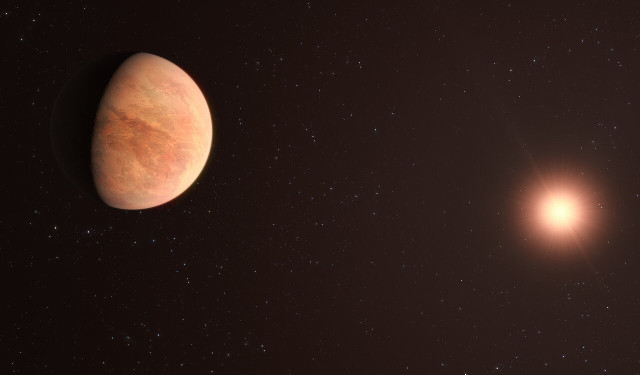
An article published in the journal “Astronomy & Astrophysics” reports a study on the planets orbiting the red dwarf star L 98-59. A team of researchers used the ESPRESSO instrument mounted on ESO’s VLT in Chile to study the characteristics of three already known exoplanets and concluded that the innermost one has a mass that is approximately half of Venus’s. There was some doubt about the nature of the outermost planet, and this study suggests that it’s a rocky planet that contains a large amount of water. The researchers found evidence of a fourth planet and clues that there might be a fifth planet.
The star L 98-59 is only 35 light-years from Earth, so it’s nearby in astronomical terms. Discovering exoplanets at a distance of this order is interesting for astronomers for the possibility of conducting high-quality follow-up observations even if the three exoplanets discovered are too close to their star to be in their system’s habitable zone.
A new study of the L 98-59 system has been conducted using the ESPRESSO (Echelle SPectrograph for Rocky Exoplanets and Stable Spectroscopic Observations) instrument mounted on the VLT (Very Large Telescope). It made it possible to exploit the radial velocity method to measure the star’s wobble generated by the gravity of the planets, which are much smaller but also very close.
The innermost planet, L 98-59b, has a mass that this study allowed to estimate to be about half of Venus’s, making it the smallest planet examined with this technique. An interesting result also arrived for the planet L 98-59d, which could contain a considerable amount of water, even up to 30% of its mass.
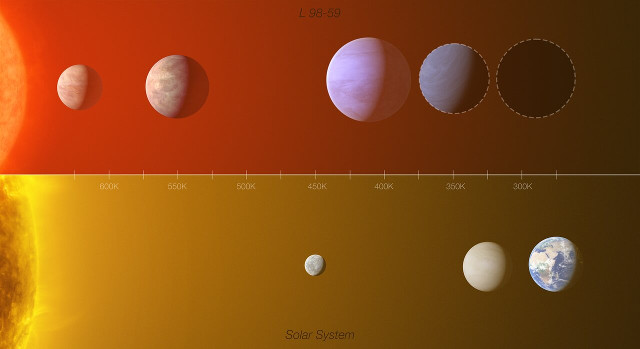
The oscillations of the star L 98-59 used in the radial velocity method indicate the presence of a fourth planet and some traces suggest that a fifth planet may also exist. A system with five planets would be very interesting, also because the fifth could be in its habitable zone. The bottom image (ESO/L. Calçada/M. Kornmesser (Acknowledgment: O. Demangeon)) shows a comparison between the exoplanets of the system of L 98-59 and the rocky planets of the solar system. The distances to their stars are not proportional because the diagram was based on the heat the planets receive.
The ESPRESSO instrument replaced the old HARPS instrument offering more precise measurements that are very useful in studies such as that of the L 98-59 system. It offers better possibilities for measuring the characteristics of exoplanets that are even smaller than Earth. In this case, this completes the information discovered with the transit method, based on the passage of exoplanets in front of their star to be identified by space telescopes such as TESS.
The years of exoplanets very close to their stars last a few Earth days, so it’s easier to spot them than more distant exoplanets that pass less often in front of their star. The radial velocity method can make it easier to discover exoplanets with longer years and may be the only way to discover exoplanets in systems that are not well aligned with the Earth. In the case of the L 98-59 system, the traces of at least one other exoplanet offer the possibility of conducting follow-up observations with various instruments hoping for a transit in front of the star.
Next-generation instruments such as the James Webb Space Telescope and the ELT (Extremely Large Telescope) will offer greater possibilities for studying exoplanets and their atmospheres. Systems such as that of L 98-59 are ideal study targets to make progress in the knowledge of rocky exoplanets and in the search for potentially habitable exoplanets.