
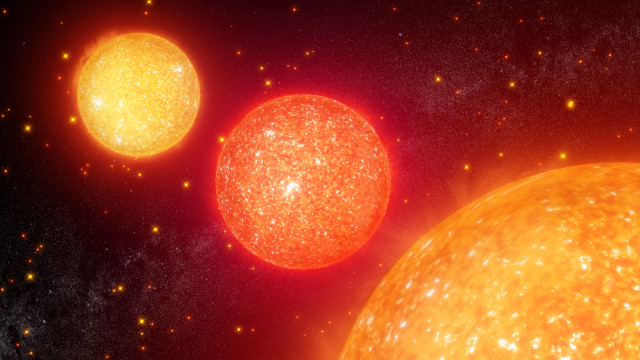
An article accepted for publication in “The Astrophysical Journal” reports the discovery of a total of 158,505 pulsating red giants. A team of researchers used the map of most of the sky created thanks to NASA’s TESS space telescope and, taking advantage of the quality of those observations, identified an unprecedented amount of this type of stars. The map analysis was conducted using a machine learning system trained to detect the traces of the oscillations in the stellar spectra of red giants. This is a very useful result for the studies of astroseismology, a branch of astronomy that studies the structure and properties of stars by analyzing their pulsations. Marc Hon of the University of Hawaii presented the results at the second TESS Science Conference, held virtually in recent days.
Processes under the surface of the stars concern the movements of gas, which rises and cools down, with the consequence that it descends and is heated again, and the cycle starts again. These flows generate sound waves which in turn generate oscillations with periods of a few minutes which result in a small change in the brightness of stars.
Many astroseismology studies have now been conducted on the Sun and other stars thanks to data collected by various space telescopes such as the French-led CoRoT mission and NASA’s Kepler mission. The TESS space telescope, launched on April 18, 2018, is NASA’s new planet hunter but over the course of its two-year primary mission, it conducted many observations of remarkable quality that have also been useful for other types of research.
Previous studies found that in red giants, stars of similar mass to the Sun’s that are going towards the end of their normal life, there may be much slower pulsations than in stars still in their normal life phase. These pulsating red giants also exhibit much greater variations in brightness that got detected by the TESS space telescope thanks to its sensitivity.
Over the two years of its primary mission, TESS covered approximately 75% of the sky. To analyze this large amount of data, the researchers trained a machine learning system to recognize pulsating red giants using the light curves of more than 150,000 stars observed in the past by the Kepler Space Telescope which include about 20,000 oscillating red giants. The result was the identification of 158,505 pulsating red giants.
The study was far from over. A further step was taken using data collected by ESA’s Gaia space probe, which created a different type of sky map that in this case was useful to measure the distances of the pulsating red giants discovered. These results made it possible to calculate the masses of the stars discovered, another important piece of data to deduce the speed of their evolution.
The pulsating red giants’ map confirms the theoretical prediction that stars that are slightly younger and slightly more massive than the Sun are closer to the galactic plane. This shows how the results of this study can be useful for other astronomical research related to the evolution of the Milky Way.
The sound waves generated in the stars have been compared to a cosmic symphony. Following this type of metaphor, different types of stars are like different musical instruments. Astronomers and especially astroseismologists look for the different sounds these stars produce because the oscillations depend on their characteristics, which can consequently be inferred when they can’t be observed. In essence, this is an excellent use of the observations conducted by the TESS space telescope to discover new exoplanets.
