
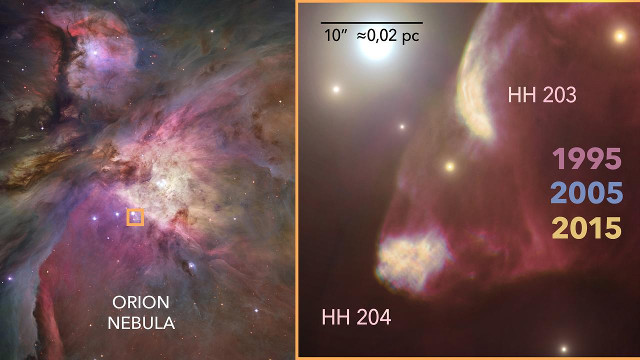
An article published in “The Astrophysical Journal” reports a study that reveals in detail never before seen the physical and chemical effects of the impact of a protostellar jet in the Orion Nebula. A team of researchers led by José Eduardo Méndez Delgado, a doctoral student at the Instituto de Astrofísica de Canarias (IAC), used observations conducted with the VLT and twenty years of images from the Hubble Space Telescope. This made it possible to examine the impact of the protostellar jet emitted by the object cataloged as HH204 on the surrounding environment and the consequent changes in the density and temperature of the gas in the Orion Nebula. This in turn caused an increase in the gas level of atoms of heavy elements such as iron and nickel.
The Orion Nebula is one of the most studied star-forming regions due to its relative proximity to Earth. In fact, it’s part of a larger complex known as the Orion Molecular Cloud Complex. Very young stars and protostars in the Orion Nebula emit jets of materials that collide with the surrounding clouds at very high speeds. The consequence is a very strong electromagnetic emission that illuminates the region.
These events generate arc-shaped structures called Herbig-Haro objects, which evolve incredibly fast from an astronomical point of view. These structures can last for several hundreds of thousands of years but changes within them can take place even in a few years. Observing them remains a long task but is largely within the reach of astronomers.
In the study of the HH204 object, there was a crucial combination of observations of the Orion Nebula area around HH204 conducted at optical frequencies with the VLT (Very Large Telescope) in Chile and in particular with its UVES (Ultraviolet and Visual Echelle Spectrograph) instrument and those conducted over twenty years with the Hubble Space Telescope.
The image (Gabriel Pérez Díaz, SMM (IAC)) shows on the left the Orion Nebula seen by the Hubble Space Telescope and on the right the zoom of HH204 with its jet of materials. Apparently, HH204 has a companion, cataloged as HH203.
The UVES spectrograph made it possible to examine the chemical composition of the area around HH204. In particular, the researchers noted an increase in heavy metals such as iron and nickel in the area affected by the protostellar jet, which is over three times more abundant than the average of the Orion Nebula. It’s a type of exam that helps to understand the chemical evolution of possible star systems in the process of formation and therefore of the solar system as well.
Another factor the researchers observed was the presence of an area of gas that was heated by the impact of the jet. The different temperatures help to recognize the various layers of the structure generated by the jet impact. In fact, various interactions have been noted in the area whose origin appears to be in various directions. The Orion Nebula is very active, so the gas is pushed around and it’s inevitable that various collisions occur at very different speeds.
It’s important to have as complete a picture as possible of what is happening around HH204 to get correct information about its evolution. The Orion Nebula is a kind of cosmic laboratory in which astronomers can see various phases of star formation that help to reconstruct the first phase of the history of the solar system as well.
