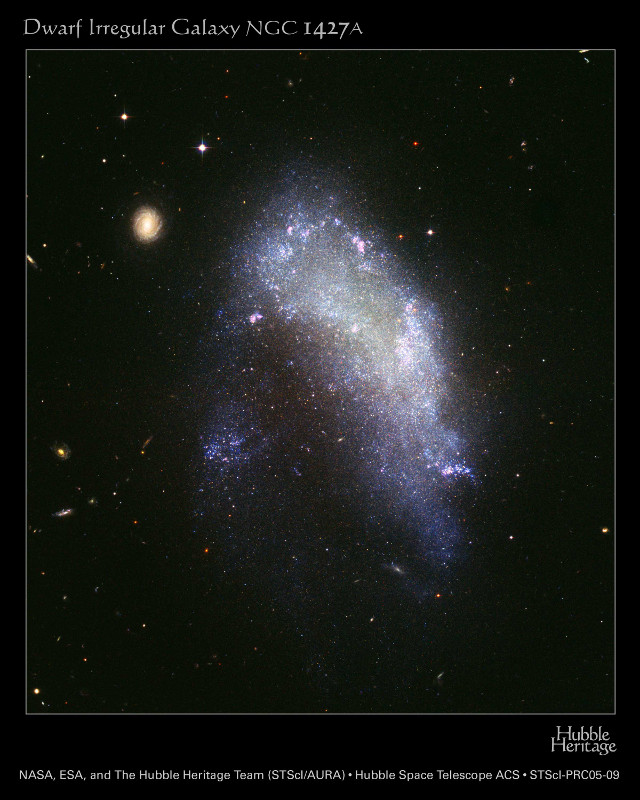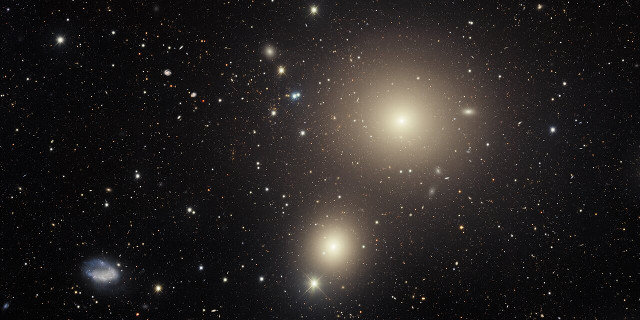
An image captured by the Dark Energy Camera (DECam) shows some galaxies in the Fornax Cluster. The galaxies NGC 1399 and NGC 1404 are two of the brightest in the cluster and their gravity is bringing them closer to the point that there may already be interactions. The irregular dwarf galaxy NGC 1427A, in the left corner in the top image, is suffering even more from the cluster’s gravitational pull and is moving towards its core. According to astronomers, it will eventually be destroyed in the distant future millions of years.
Just over 60 million light-years from Earth, the Fornax Cluster is the second most populous galaxy cluster, with over 600 galaxies, within 100 million light-years of Earth after the Virgo Cluster. The situation in the Fornax Cluster is dynamic, in the sense that it’s divided into two sub-clusters that are interacting in what is a merger of what were originally two separate clusters.
With over 600 galaxies, there are many interactions, for example, the growing ones between galaxies NGC 1399 and NGC 1404, centered in the top image (CTIO/NOIRLab/DOE/NSF/AURA. Acknowledgment: Image processing: T.A. Rector (University of Alaska Anchorage/NSF’s NOIRLab), J. Miller (Gemini Observatory/NSF’s NOIRLab), M. Zamani (NSF’s NOIRLab) & D. de Martin (NSF’s NOIRLab)), whose mutual attraction is bringing them closer together.
The movement is causing NGC 1404 to leak gas because of the pressure of the plasma present among this cluster’s galaxies. According to research such as the one published in the journal “Monthly Notices of the Royal Astronomical Society” in October 2003, the interactions with its neighbor caused the loss of most of its globular clusters.
Another interesting interaction is that of the irregular dwarf galaxy NGC 1427A with the rest of the Fornax Cluster. NGC 1427A is traveling towards the center of the cluster at a speed of about 2.2 million kilometers per hour. It’s so fast that NGC 1427A got deformed into the arrowhead shape we see from Earth and can be seen in particular in the bottom image, captured by the Hubble Space Telescope.
According to astronomers, the galaxy NGC 1427A will be destroyed within the next billion years due to its interactions with other galaxies in the Fornax Cluster and with the gas present among those galaxies. Probably, such an event was common when the universe was much younger but has become rarer over time.
The DECam is used for various types of cosmological research and is not a substitute for instruments such as the Hubble Space Telescope or other telescopes. However, the ability to photograph large portions of the sky offers images that are useful to astronomers in various ways. In this case, it’s useful to study the interactions among galaxies in the Fornax Cluster.