
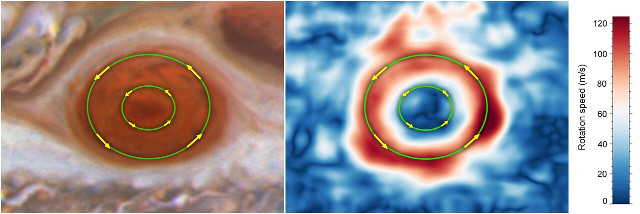
An article published in the journal “Geophysical Research Letters” reports a study on the changes that occurred in the winds present in the famous Great Red Spot on the planet Jupiter. A team of researchers analyzed observations conducted with the Hubble Space Telescope between 2009 and 2020 to conclude that the winds in the outer zone of the Great Red Spot are accelerating. On the contrary, the winds near the innermost region of the colossal Jovian storm are slowing down.
The larger-than-Earth storm that has been continuing for who knows how many centuries on Jupiter has stimulated the imagination of generations of astronomers and ordinary people to the point of becoming an iconic part of the great planet. Countless observations of the Great Red Spot have been conducted in the course of constant monitoring that has continued for nearly two centuries. However, there are very few instruments that can offer a spatial resolution of that storm sufficient to assess the speed of the winds within it. The Hubble Space Telescope allows astronomers that kind of performance, and its longevity has provided over an Earth’s decade of observations.
The analysis of the collected data, led by Michael Wong of the University of California, Berkeley, showed variations over time in the speed of the winds in the Great Red Spot. There are very different variations between the outer area and the one close to the innermost region. In fact, the speed of the winds increased in the outer area while it decreased around the innermost region.
The image (NASA, ESA, Michael H. Wong (UC Berkeley)) shows the Great Red Spot with green circles indicating the areas where changes in wind speeds have been detected. In the box on the right is a diagram of those speeds.
The increase in wind speed in the outer area of the Great Red Spot is small, being less than 2.5 kilometers per hour for each Earth year. It really took a series of observations conducted over several years with an instrument like the Hubble Space Telescope to be able to measure it.
Even Hubble has limitations when it comes to detecting what goes on in the Great Red Spot’s depths. This makes it difficult to understand the meaning of the variations in wind speeds within it. According to Michael Wong, this is an interesting piece of the puzzle that can help us understand what is fueling the Blot and how it maintains its energy.
This study adds to others that, in recent years, led to discussions regarding the evolution of the Great Red Spot. Some research indicated it was shrinking but a study presented in November 2019 offers a different explanation. This iconic storm is a sort of laboratory for studying storms of this type: there are many smaller ones on Jupiter and other planets and the physical phenomena behind them are the same, so the studies will continue.
