An article published in “The Astrophysical Journal” reports a study on the supernova remnants cataloged as G344.7-0.1. A team of researchers combined observations in different bands of the electromagnetic spectrum to study the consequences of a Type Ia supernova, the explosion of a white dwarf that reached critical mass after stealing gas from a companion. These remnants can show in particular the effects of what is called reverse shock and offer new information to better understand these supernovae, important in the creation of elements such as iron that are scattered in interstellar space.
White dwarfs are the remnants of a star with a mass similar to the Sun’s at the end of its normal life. If it remains undisturbed, it’s a very stable object that slowly cools down over many billions of years. In theory, it eventually becomes a black dwarf but there are still obscure aspects of the processes that can take place in a white dwarf. Some information can come from white dwarfs that steal gas from other stars in binary or multiple systems until they reach a critical mass that triggers a Type Ia supernova.
Almost 20,000 light-years from Earth, a white dwarf exploded and the evolution of the remnants of that Type Ia supernova, cataloged as G344.7-0.1, can offer interesting information. According to estimates, we are seeing those remnants between 3,000 and 6,000 years after the explosion, in an important phase called the reverse shock. It occurs when debris moves outward from the initial explosion but encounters resistance from the surrounding gas, causing them to slow down. The result is a shock wave that returns towards the center of the explosion with a further generation of energy which manifests itself in emissions that include X-rays.
Some well-known supernovae observed throughout human history are too young from Earth’s point of view to have already reached the reverse shock phase. Instead, we see G344.7-0.1 at the right time to be able to observe the reverse shock.
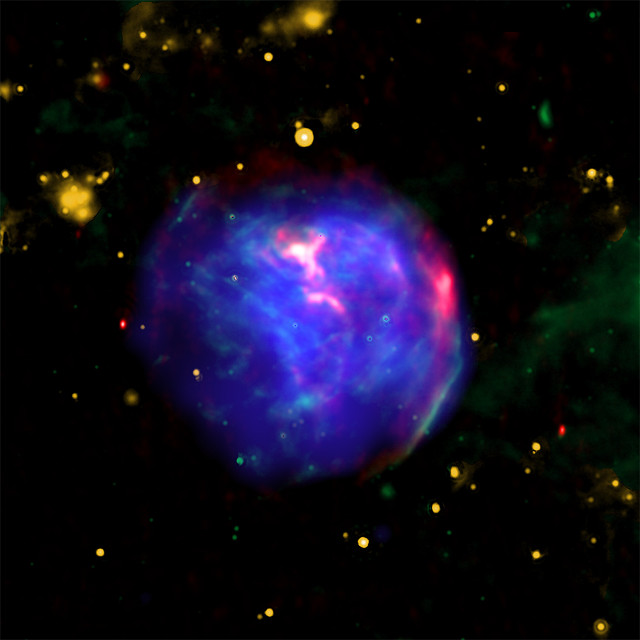
The researchers used different instruments to detect the various emissions from G344.7-0.1. The X-rays emitted due to the reverse shock were detected by NASA’s Chandra X-ray Observatory. Other observations were conducted with NASA’s Spitzer Space Telescope to detect infrared emissions and with two radio telescopes, the Very Large Array (VLA) and the Australia Telescope Compact Array (ATCA), to detect radio emissions.
The X-ray emissions detected by Chandra offer the possibility to observe the materials at the center of the explosion. Thanks to the reverse shock, it’s possible to observe in G344.7-0.1 something more than other Type Ia supernova remnants with different ages.
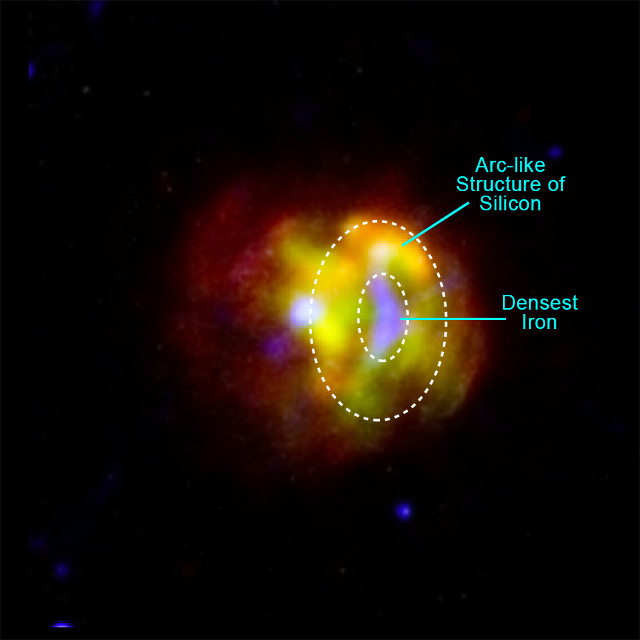
The bottom image (NASA/CXC/Tokyo Univ. of Science/K. Fukushima, et al.) captured by Chandra shows G344.7-0.1 in three colors with the region of the highest iron density in blue surrounded by arc-like structures of silicon arc in green. Similar arc-like structures are present for other elements: sulfur, argon, and calcium.
The analysis of the data collected with Chandra suggests that the region with the highest density of iron was heated by the reverse shock more recently than the other elements of the arc-like structures. This would mean that that iron is located in the very center of the stellar explosion.
The results of the observations of G344.7-0.1 are consistent with the model predictions for Type Ia supernovae. This phase of the evolution of those supernova remnants lasts little in astronomical terms but very long from the human point of view, leaving plenty of time for further study.