An article (link to the PDF document) published in the journal “Nature Astronomy” reports the identification of a candidate exoplanet in another galaxy, cataloged as M51-ULS-1b. A team of researchers used NASA’s Chandra X-ray Observatory and ESA’s XMM-Newton Space Telescope to examine what could be the transit of a Saturn-sized exoplanet in M51, a pair of galaxies. In the larger of the two galaxies, there’s an ultra-luminous X-ray source consisting of a dead star and a blue supergiant, and the candidate exoplanet orbits them. The first confirmation of an extragalactic exoplanet would be extraordinary but in this case, not all alternative explanations can be completely ruled out.
The transit method has been used for a long time to identify the passage of exoplanets in front of a star from the point of view of a telescope such as Kepler in the past and now TESS. However, all exoplanets detected by these and other telescopes with this method are in the cosmic neighborhood, in the Milky Way area around the solar system. X-ray sources could make it possible to identify the transit of exoplanets even millions of light-years away.
One of the problems in the search for extragalactic exoplanets is that millions of light-years away it becomes difficult even to distinguish the light of different stars. X-ray sources can be binary systems composed of a compact dead star, such as a neutron star or a black hole, and a blue giant companion. The compact object steals gas from its companion and that gas accelerates and is heated to the point of emitting large quantities of X-rays. These are rare systems, so it’s possible to search for possible transits even in other galaxies.
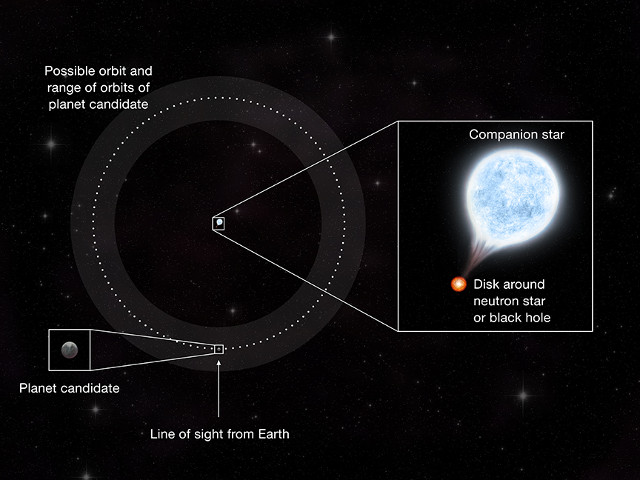
M51-ULS-1 is a so-called X-ray binary in the largest of the M51 galaxies and was observed using NASA’s Chandra X-ray Observatory and ESA’s XMM-Newton Space Telescope. The top image (NASA/CXC/SAO/R. DiStefano, et al.; Optical: NASA/ESA/STScI/Grendler) shows M51 and an illustration of the system that could host an exoplanet. On the left side, a combination of observations of M51 conducted at X-rays with Chandra and at optical frequencies with the Hubble Space Telescope. The inset shows the area around M51-ULS-1. On the right side, an illustration of the observed system with, in the foreground, the compact object surrounded by very hot gas stolen from the blue supergiant companion. The bottom image (NASA/CXC/M. Weiss) illustrates the system with the possible orbit of the candidate exoplanet.
Rosanne Di Stefano of the Center for Astrophysics, Harvard & Smithsonian, the first author of the article, explained that the X-ray source she studied with her colleagues is smaller than Jupiter. This means that a transiting exoplanet could completely block the light from that source.
M51-ULS-1 is an X-ray source in the pair of galaxies known as M51. It’s formed by the dwarf galaxy M51b, also known as NGC 5195, and the spiral galaxy M51a, also known as NGC 5194 or the Whirlpool galaxy, which are interacting in an early phase of a galaxy merger, although the considerable difference in size between the two galaxies probably makes it more appropriate to say that NGC 5194 will devour the smaller companion.
Observations of M51-ULS-1 with Chandra and XMM-Newton revealed that the X-ray source was completely obscured for a few hours. The researchers ruled out various reasons that the blockage is caused by a brown dwarf, a white dwarf, a cloud of gas and dust, changes in brightness of the compact object that emits the X-rays, or the transit of its companion.
Simulations indicate that if it’s indeed an exoplanet transiting in front of M51-ULS-1, it’s similar in size to that of Saturn and its year lasts 70 Earth years. This severely limits the possibilities of study and consequently the possibilities of verifying the actual existence of the exoplanet candidate cataloged as M51-ULS-1b.
The clues collected on M51-ULS-1b indicate that it’s indeed an exoplanet but the impossibility of observing other transits in a short time leaves the doubt that there’s another cause for the blockage. However, the method used to find this candidate is valid to observe other binary systems of that type in search of other possible extragalactic exoplanets.