
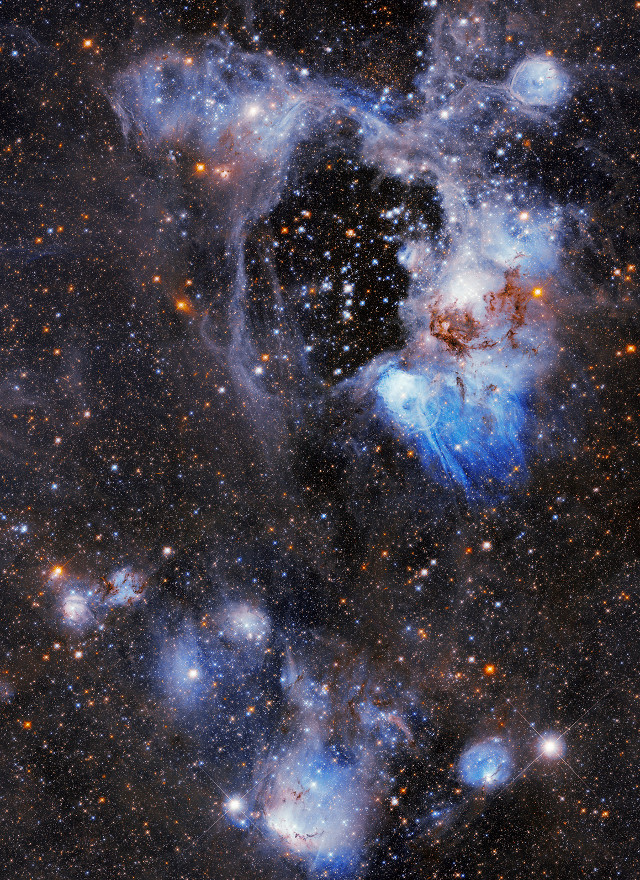
NASA has released an image captured by the Hubble Space Telescope of N44, an emission nebula in the Large Magellanic Cloud. Its classification is due to the fact that it glows because of electromagnetic emissions generated by the ionization caused by the stars present in that area. A really curious formation inside it is what was called a superbubble, a kind of cavity inside N44 that’s still without a certain explanation. The stellar winds in the nebula don’t seem to have the necessary characteristics, so the most widely considered hypothesis is that the cavity was excavated by supernovae.
The Great Magellanic Cloud is a dwarf galaxy satellite of the Milky Way. Its relative proximity has made it an object of study for astronomers for a long time. The N44 emission nebula, 170,000 light-years from Earth, is within this dwarf galaxy. It’s a nebula full of stars of various ages whose winds ionize the gas still present, making it glow. These stellar populations make N44 interesting but astronomers are trying to understand the nature of the superbubble, the cavity visible in the center of the upper part of the image.
The first hypothesis proposed by the astronomers was that the winds from the stars in the N44 nebula swept away the gas in an area about 250 light-years wide, creating the superbubble. However, calculations of the speed of those winds give inconsistent results with such an effect.
Another hypothesis, currently considered the most likely, is that the superbubble was excavated by supernovae. This makes sense when considering the remarkable amount of massive stars in the nebula that end their lives with that type of explosion.
A supernova remnant was discovered near the superbubble. The researchers estimated that there’s a difference of about 5 million years between the age of the stars inside the superbubble and those at its edges. This indicates that there were several star formation events over time with chain reactions. The deep blue area at the bottom right of the superbubble is one of the hottest in the nebula as star formation is more intense.
The study of the N44 nebula with the Hubble Space Telescope is suspended because Hubble’s instruments entered the so-called Safe Mode on October 25 causing the suspension of activities. The Hubble team is investigating to understand the nature of the problem. Meanwhile, astronomers are studying the images captured before the problem emerged, including that of N44.
