
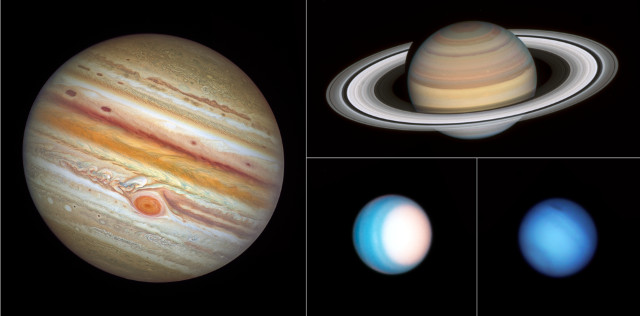
A composition of images captured by the Hubble Space Telescope brings together the solar system’s giant planets on a grand tour of the outer planets. Jupiter, Saturn, Uranus, and Neptune are among the targets of periodic observations in programs such as OPAL (Outer Planets Atmospheres Legacy) to keep an eye on the changes that occur over time in their atmospheres. Along with other instruments, which in some cases include space probes, Hubble is an important contributor to studies of gas planets. Programs such as OPAL are also useful in developing models for studying gas exoplanets in other star systems.
In the 1960s, NASA planned a grand tour of the outer solar system in a space probe program. When discussing funding, the costs were deemed too high but eventually, the Voyager probes were developed and, before venturing into interstellar space, in the late 1970s and early 1980s they visited the solar system’s gas giant planets.
In the following years, other space probes offered unprecedented images of some planets and Juno is currently orbiting Jupiter but only telescopes observe them all periodically and Hubble is one of the most important. This year, Hubble captured some images of the gas planets during September and October. The image (NASA, ESA, Amy Simon (NASA-GSFC), Michael H. Wong (UC Berkeley). Processing: Joseph DePasquale (STScI)) shows them together.
On September 24, Hubble captured an image of Jupiter showing various changes in its atmosphere. Storms appear and disappear over time but some of them last a very long time, starting with the iconic Great Red Spot. Below it is another smaller Red Spot that has been joined by other anticyclonic storms.
On September 12, Hubble captured an image of Saturn showing rapid and extreme color changes of the bands in the planet’s northern hemisphere, where it’s now early autumn. The season allows us to see the hexagonal storm at the north pole, which was difficult to distinguish in 2020.
On October 23, Hubble captured an image of Uranus showing how the northern polar region is getting brighter thanks to the increased absorption of ultraviolet solar radiation over the course of spring. This is useful in studying brightness variations due to changes in methane and hazy particles concentration in the atmosphere.
On September 7, Hubble captured an image of Neptune showing the evolution of a large dark spot. This great storm has been followed in its movements over time. For a time, a smaller dark spot appeared in that area, a storm possibly originating from the larger storm that moved away and then disappeared. Another object of study is the dark elongated circle around the planet’s south pole.
The Hubble Space Telescope’s longevity made it possible to create a remarkable archive that also includes an annual grand tour of the solar system’s gas giants. This longevity is being challenged by issues that have been limiting the use of Hubble in recent weeks but the team that runs it is doing everything possible to fully restore it and continue to obtain stunning images that offer important scientific information.
